Learning how to choose creatine is mostly a label-reading skill, not a brand-hunting one. Two tubs can share a name and still differ in serving weight, servings per pack and added ingredients. This guide gives you a repeatable way to compare them before you order.
It is written for shoppers buying from the current Scitec Nutrition range in Lebanon. Think of it as a creatine buyer’s guide rather than a ranking: a process you can run on any label, in any store, on any day.
Disclosure: Muscle Plus is the exclusive Scitec Nutrition agent in Lebanon, and this guide links to Muscle Plus product pages. Label details were checked on 6 November 2026. Always let the live page and the pack in your hand take priority.
The short answer: choose plain creatine monohydrate. Confirm the grams of creatine per serving, not the scoop size. Pick the format you will use daily, then calculate cost per serving from the stated servings per pack. Everything else here is the detail behind those four steps.
Start with the label, not the ranking
Most “best creatine” articles hand you a list. That list rarely survives the trip to your local shelf. A fixed set of checks works better, because you can run it on whatever product you are holding.
Use three steps. First, confirm the form and the ingredient. Second, read the numbers on the label. Third, compare pack value and seller details on the same date.
That is the honest answer to how to choose creatine: a method you can repeat, not a tub someone else picked.
How to choose creatine in three questions
- What am I buying? A creatine monohydrate product, or a blend built on a different form.
- How much creatine is in a serving? The scoop weight does not answer this. The declared creatine figure does.
- What does it cost per serving? Pack price divided by stated servings, checked on the day you shop.
What this guide deliberately leaves out
Dosage, loading phases and timing already have their own article. Flavoured and unflavoured formulas are compared in more depth elsewhere on this blog. This page stays on the purchase decision.
That focus matters. Search results for “how to choose creatine” mix three genres. You get form explainers, US product listicles and label guides. Only the last one helps you at the shelf.
Decide the form before you compare brands
Creatine is sold as monohydrate, hydrochloride, ethyl ester, buffered blends, liquids and more. The names suggest choice. The evidence is far less varied than the shelf. How to choose creatine therefore starts with the form, not the brand.
Most published research uses creatine monohydrate. The International Society of Sports Nutrition position stand calls it the most studied form and the benchmark for every other one. The NIH Office of Dietary Supplements says the same in consumer language.
Why monohydrate is the reference point
Monohydrate is a creatine molecule bound to water. It is inexpensive to produce and stable as a powder. That combination is why so much research uses it.
The authorised European claim also sits on this form. EFSA concluded that 3 g of creatine per day increases physical performance in successive bursts of short-term, high-intensity exercise. That claim appears in the EU Register of health claims.
What other forms actually change
Alternative forms are marketed on absorption, solubility or stomach comfort. Head-to-head studies have not shown them beating monohydrate on strength or lean mass. The ISSN position stand reviews this directly, and a later ISSN review of common creatine questions reaches the same conclusion.
A different form can still be a legitimate product. It is simply not a better molecule. Treat the form name as a starting filter, not a reason to pay a premium.
If you want the wider picture on forms and myths, read our creatine supplement guide.
Powder, capsule or chew: pick the format you will use
Format changes convenience, not chemistry. Powder gives you dose flexibility and the lowest cost per gram in most ranges. Capsules and chews remove measuring, and often cost more per gram.
Ask one question. Which format will you still be using in three months? A slightly pricier format you actually take beats a cheap tub that sits in a cupboard.
How to read a creatine monohydrate label
A creatine label has five fields worth your attention. Read them in order. Each one can change your decision before price enters the conversation.
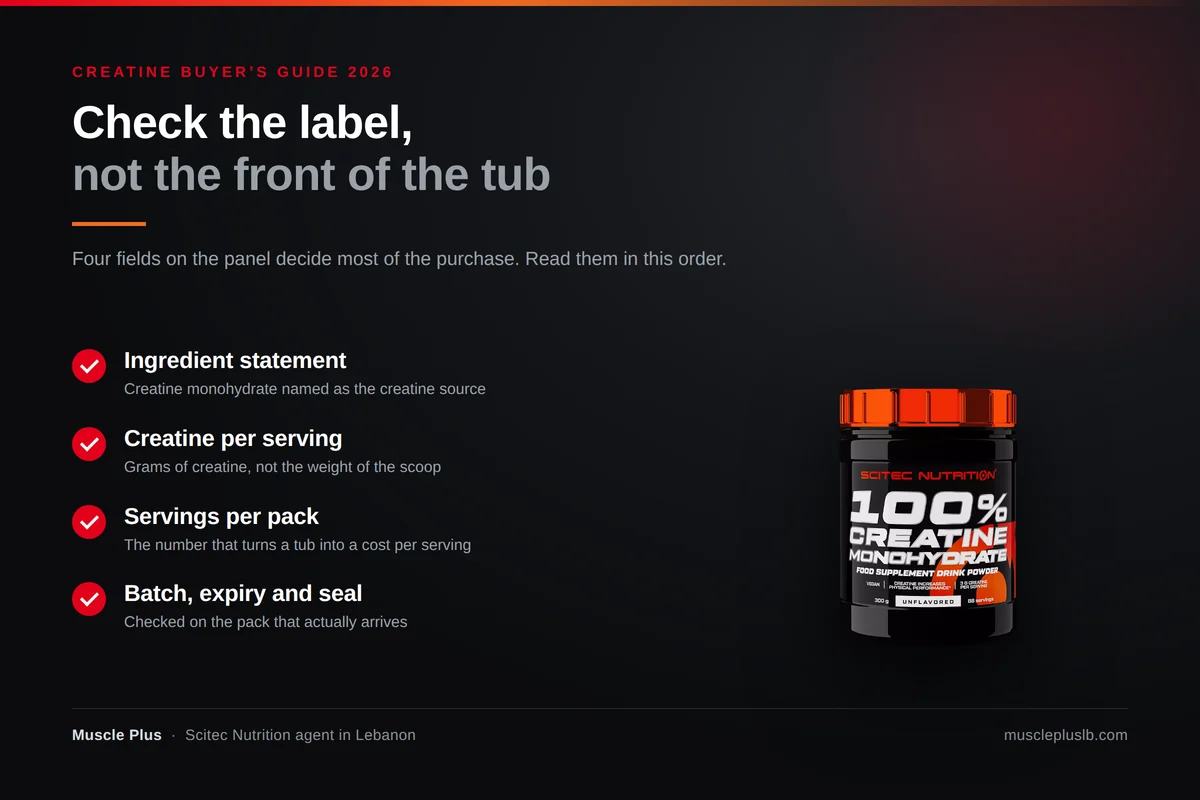
Field 1: the ingredient statement
Find the ingredient list, not the product name. A tub called “100% Creatine Monohydrate” can still contain flavourings and sweeteners. The ingredient panel settles it.
Look for creatine monohydrate as the declared creatine source. If you see a blend, check whether each component is listed with an amount. Amounts you cannot see are amounts you cannot compare.
Field 2: serving size versus creatine per serving
This is the field most shoppers misread. Serving size tells you how much powder to scoop. It does not tell you how much creatine you get.
A flavoured serving often weighs more than an unflavoured one, because flavour systems add mass. The creatine figure may be identical. Read both numbers together, every time.
Field 3: the rest of the formula
Flavoured products list flavourings, acids, colours and sweeteners such as sucralose. Check them if you avoid specific ingredients. A shorter list is not automatically better, but it is easier to audit.
Also check the allergen line. Some labels flag shared manufacturing sites rather than the product itself. Read the exact wording instead of assuming.
Field 4: directions and warnings
Directions tell you the intended daily serving and how much water to use. Follow the pack, not a generic scoop instruction from another product.
Warnings matter for suitability. Many creatine labels exclude use under 18, during pregnancy or nursing, or alongside a medical condition. Treat those lines as part of the buying decision.
Field 5: pack size, servings and the date you checked
Servings per pack is the number that turns a tub into a cost. Note it beside the pack weight. A 300 g tub can hold 60 servings or 88, depending on serving weight.
Write the date next to any figure you record. Prices and formulas move. A comparison without a date is a rumour.
| Label field | Where to find it | What a clear label shows | What to treat as unclear |
|---|---|---|---|
| Ingredient statement | Ingredient panel | Creatine monohydrate named as the creatine source | A blend with no individual amounts |
| Creatine per serving | Supplement Facts or nutrition table | A gram figure for creatine, separate from powder weight | Only a scoop weight, or a percentage of the formula |
| Other ingredients | Ingredient panel | Flavourings, sweeteners, acids and colours listed | “Flavour system” or “premium matrix” with no detail |
| Directions and warnings | Back or side panel | Daily serving, water volume, suitability warnings | No serving instruction at all |
| Pack size and servings | Front label and nutrition table | Net weight plus stated servings per pack | Servings you have to guess from a photo |
The US FDA labelling guide explains what a supplement label is required to carry in its own market. It is a useful checklist for reading any panel, not proof of local registration.
Flavoured versus unflavoured creatine
Flavour is a format decision. It changes ingredients, scoop weight and preparation. It does not change the creatine molecule inside the tub.
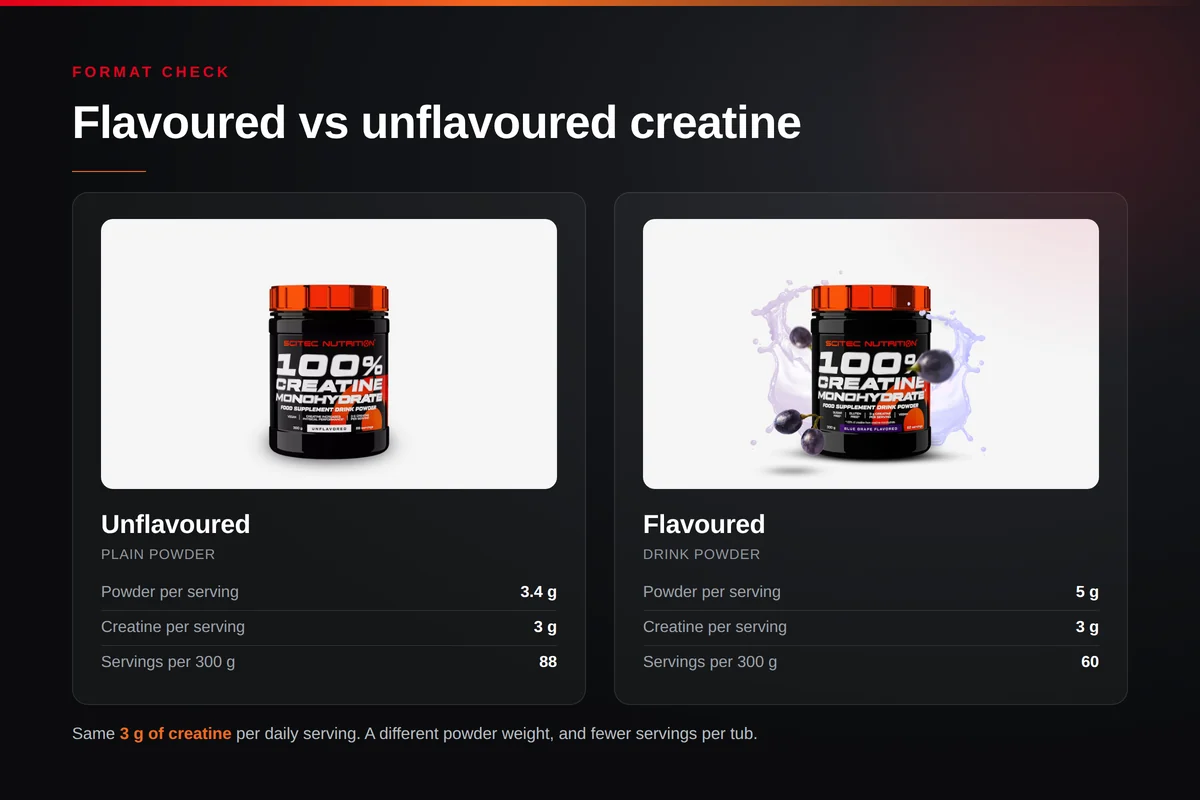
The current Scitec range makes the point clearly. Both products declare the same creatine per daily serving. Their powder weights and serving counts differ.
What unflavoured creatine suits
Unflavoured powder is the flexible option. It disappears into a protein shake, juice or a drink you already make. The ingredient list stays short.
On the current label, one 3.4 g serving is entirely creatine monohydrate. That provides 3 g of creatine, and the 300 g tub holds 88 servings.
What flavoured creatine suits
Flavoured powder is a standalone drink. You add water, shake, and you are done. That suits anyone who does not want another shake in the day.
The current flavoured label lists 5 g of powder per serving. Of that, 3.4 g is creatine monohydrate, providing 3 g of creatine. The remaining mass is the flavour system, and the tub holds 60 servings.
What both formats still require you to check
- The declared creatine figure, not the scoop size.
- The full ingredient list, including sweeteners.
- The stated servings per pack.
- The daily serving and water volume on the label.
The deeper comparison lives in our guide to flavoured versus unflavoured creatine. Read it before you pick a side.
| Criterion | Unflavoured | Flavoured |
|---|---|---|
| Ingredient list | Often a single ingredient | Creatine plus flavourings, acids and sweeteners |
| Creatine per serving | 3 g from 3.4 g monohydrate (current label) | 3 g from 3.4 g monohydrate (current label) |
| Powder per serving | 3.4 g | 5 g |
| Servings per 300 g tub | 88 | 60 |
| Preparation | Mix into any drink | Mix with water as a standalone drink |
| Main advantage | Flexibility and shorter ingredient list | Convenience and a drink you enjoy |
| Main trade-off | Mild taste in plain water | Extra ingredients and a larger scoop |
| Verify before buying | Serving weight and servings per pack | Sweeteners, flavour stock and serving weight |
Compare pack value, not tub price
Tub price alone cannot tell you which product is better value. The tubs may hold different amounts of creatine. Two arithmetic steps fix that.
The two calculations that matter
First, multiply servings by creatine per serving. That gives you the total creatine in the pack. Second, divide the current price by servings. That gives you cost per serving.
Do both on the same date, in the same currency. Record the date beside the result. Then compare only products with visible serving counts.
A worked label comparison
Take the two current Scitec labels. The unflavoured tub gives 88 servings at 3 g of creatine each. That is roughly 264 g of creatine in 300 g of powder.
The flavoured tub gives 60 servings at 3 g each. That is roughly 180 g of creatine in the same 300 g pack weight.
Same declared dose per serving. Same tub weight. Different amount of creatine per pack, because the flavour system takes up mass. Check the live product pages for current listed prices before you calculate cost.
Pack size traps to watch
- Bigger tub, fewer servings. Serving weight can rise while servings fall.
- “Up to” serving claims. A range is not a fixed count.
- Scoop-only instructions. A scoop is a volume measure, not a creatine dose.
- Old screenshots. A saved price from last season is not a comparison.
- Delivery costs. Add shipping before you declare a winner.
None of this makes a larger or smaller pack wrong. It just means value has to be calculated, not eyeballed.
Read the online listing as carefully as the label
Most creatine in Lebanon is bought from a product page, not a shelf. Until the parcel arrives, that page is the label. Treat it the same way.
Fields that are often missing online
- Net weight, in grams or pounds.
- Servings per pack.
- Creatine per serving.
- The full ingredient panel, not a marketing paragraph.
- Flavour options, and which size each one applies to.
If a page shows a tub photo but no servings figure, you cannot calculate value. Ask before ordering, or choose a listing that states the number.
Why the variant selector changes the maths
One page can cover several sizes or flavours. The price at the top may belong to the smallest option or the default variant. Check the selection before you compare anything.
The same applies to flavour. A page listing four flavours may only hold stock in two. Confirm the one you want is selectable, and that the serving count matches the size you chose.
What to do when a listing is vague
Ask a specific question. “How many servings are in the 300 g tub? How many grams of creatine are in one serving?” A seller who stocks the product can read both answers from the pack.
A vague answer is information too. If nobody can confirm the serving count, the comparison cannot be finished, and the purchase can wait.
Keep a record of what you compared
Note the page, the date and the figures you used. If the delivered pack differs, you have something concrete to discuss. The habit takes seconds and settles most disagreements.
Nothing here changes the method. Read the actual numbers, note the date, and let the label outrank the marketing copy.
Check the pack, the seller and the batch
Label reading covers the product. Pack checks cover the thing that arrives at your door. Both belong in a buying decision.
What to inspect when the pack arrives
- The exact product name, flavour and size you ordered.
- An intact tamper seal and an undamaged lid.
- A readable batch or lot code.
- A clear expiry or best-before date.
- The ingredient panel matching the page you bought from.
If the label and the listing disagree, stop and ask before you use the product. Do not average the two.
Why the seller matters in this category
Creatine is a commodity powder. Packaging, storage and sourcing decide what you actually receive. A named importer and a traceable order make a problem solvable.
Muscle Plus is the exclusive Scitec Nutrition agent in Lebanon, so the brand route is direct rather than through a reseller chain. That is a commercial fact about the seller, not an independent quality certificate.
What a certification can and cannot tell you
Third-party programmes check identity, label accuracy and, in sport schemes, banned substances. They are useful where they apply. They do not prove the product suits you.
Ask which product and which batch a certificate covers. A seal on one flavour does not automatically extend to another. If you compete under anti-doping rules, verify the exact item.
The creatine buying checklist
Run this list once, in order, before you add anything to a cart. It takes about five minutes and prevents most expensive mistakes.
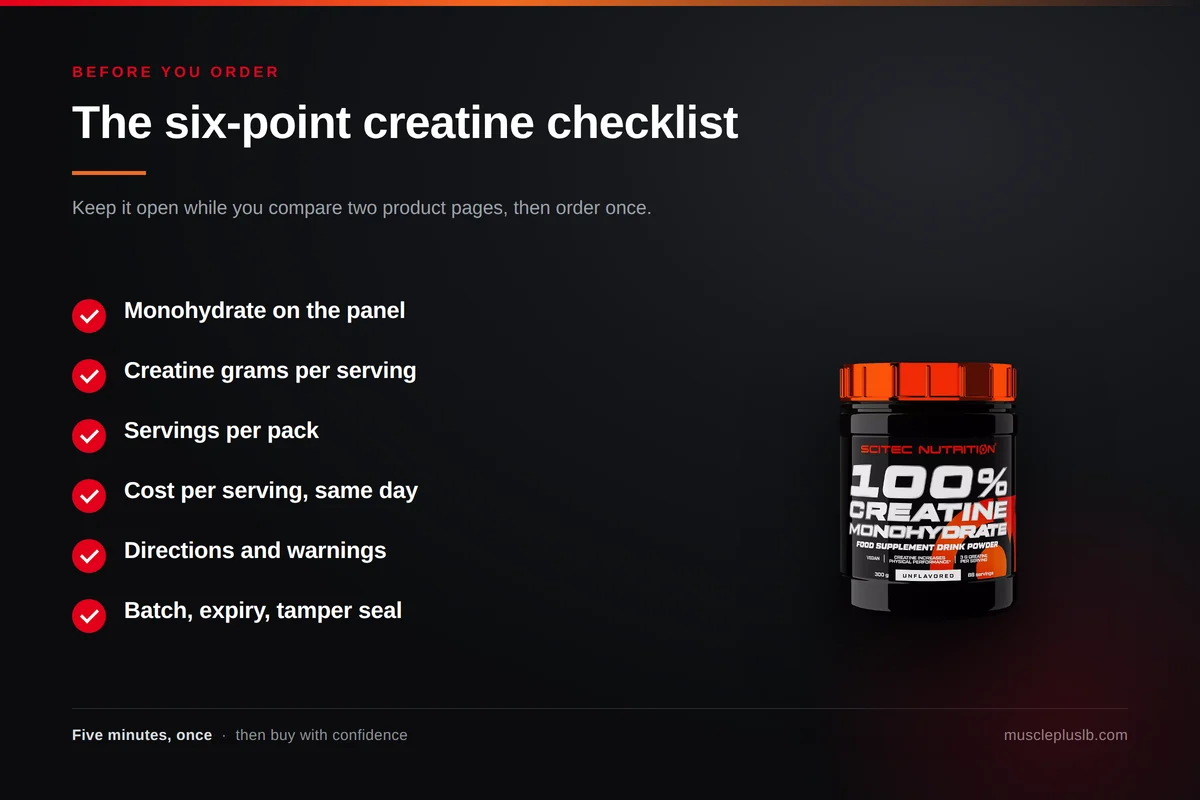
- Confirm the creatine form is monohydrate.
- Read the ingredient panel, not the product name.
- Note the creatine grams per serving.
- Note the powder grams per serving.
- Note the servings per pack.
- Multiply servings by creatine per serving.
- Check the current price and calculate cost per serving.
- Read the directions and the suitability warnings.
- Confirm the flavour and pack size you actually want.
- Check the seller, batch code, expiry date and tamper seal on arrival.
Keep the ten answers together. If two products tie on the first nine points, buy the one you will use consistently.
That is the whole of how to choose creatine, in one page. Everything before this section explains why each line exists.
Five buying mistakes that cost money
These five errors explain most creatine buying regret. Each one is avoidable with a single label check.
Comparing tub prices instead of servings
Two tubs at the same weight can hold 60 or 88 servings. Price per tub hides that. Cost per serving exposes it.
Assuming a bigger scoop means more creatine
A 5 g flavoured scoop and a 3.4 g unflavoured scoop can both deliver 3 g of creatine. Powder weight includes flavourings, acids and sweeteners.
Paying extra for an “advanced” form
Newer forms cost more and carry thinner evidence. The ISSN position stand found no consistent advantage over monohydrate. Premium pricing is not a purity signal.
Trusting reviews instead of the label
Reviews describe taste, mixing and delivery. They cannot tell you the creatine per serving. Read the panel first and the reviews second.
Buying a pack size you will not finish
A large tub is only good value if you use it. Check the expiry date against your realistic daily routine. A smaller pack that stays fresh beats a bargain that goes stale.
Where dose and routine fit in the decision
This is a buying guide, so it will not prescribe a dose. Two reference points help you read labels sensibly.
What the 3 g claim actually says
The EFSA claim is tied to 3 g of creatine per day. That is the figure behind the authorised wording on European labels. It describes a daily intake, not a scoop size.
Why loading is optional
Research protocols often use 3 to 5 g per day for maintenance. Loading uses larger divided doses to reach saturation faster. It is a timing choice, not a requirement.
Our guide to how to take creatine for best results covers dosage, loading and timing in detail. Read it after you have chosen a product.
Who should ask a professional first
Creatine research is reassuring for healthy adults at recommended intakes. That is not clearance for everyone. Some situations need individual advice before purchase, not after.
Speak to a doctor or pharmacist first if you have kidney disease or another medical condition. Do the same if you take regular medication, are pregnant or nursing, or are under 18.
Also ask if you have had a reaction to a supplement before. Tell your clinician you use creatine before kidney-function testing, because it can affect how a result is read.
A shopping guide cannot assess your situation. Use it to compare products, and use a qualified professional for suitability.
Frequently asked questions about how to choose creatine
Is creatine monohydrate better than other forms?
Monohydrate has the widest research base and is the form most studies use. The ISSN position stand treats it as the reference standard. Other forms have not shown consistent advantages in head-to-head comparisons.
How do I know how much creatine is in a serving?
Read the declared creatine figure, not the scoop weight. A 5 g scoop of flavoured powder may contain 3.4 g of creatine monohydrate, providing 3 g of creatine. The panel states the number.
Does a bigger tub always mean better value?
No. Compare servings per pack and creatine per serving first. A 300 g tub can hold 60 or 88 servings depending on serving weight, so the amount of creatine per pack differs.
Is flavoured creatine as good as unflavoured?
Flavour does not change the creatine molecule. Compare the declared creatine per serving and the full ingredient list. The current Scitec labels declare the same 3 g of creatine per daily serving in both formats.
Should I buy powder, capsules or chewables?
Buy the format you will use daily. Powder is usually the most flexible and the cheapest per gram. Capsules and chews remove measuring but often cost more for the same creatine.
Do I need to check for third-party testing?
It helps if you want an independent check on identity or banned substances. Ask which product and batch a certificate covers. A certification is useful evidence, not proof of personal suitability.
What should I check when the pack arrives?
Check the product name, flavour and size against your order. Then check the tamper seal, batch code, expiry date and ingredient panel. Contact the seller if anything differs.
Can I compare creatine prices from different months?
Not reliably. Formulas, pack sizes and prices change. Recheck the live page on the day you buy, and record the date beside your calculation.
Is creatine suitable if I have a medical condition?
Ask your doctor or pharmacist before buying. Kidney disease, medication use, pregnancy, nursing and being under 18 all warrant individual advice. This guide does not assess suitability.
Compare the current creatine range
You now have a process for how to choose creatine: form, label, format, value, then pack and seller checks. The last step is comparing live pages with that process in hand.
Start with the current creatine in Lebanon collection. It lists the unflavoured and flavoured options side by side, with servings on each product page.
If you want a plain powder for an existing shake, look at Scitec 100% Creatine Monohydrate. If you want a standalone drink, compare flavoured creatine monohydrate.
Check the current listed price and availability on the live page before ordering. Prices and stock move, and the pack in your hand is the final label.
Written by
Muscle Plus Editorial Team — Supplement Experts
The editorial team has product-category experience with creatine formats, labels, and current shopping pages. Muscle Plus has a commercial relationship as the exclusive Scitec Nutrition agent in Lebanon. This is not an independent product review. Independent educational claims in this guide are cited to the linked authority sources.
Last reviewed: November 7, 2026