
Quick answer
This protein calculator estimates a daily protein amount using the information you enter. It also shows estimates for carbohydrates, fat and calories. Start with the result as a planning guide, not a prescription. Your needs can vary with your body, activity, goals and health. Food can often meet your needs; protein powder is optional.
Discover Your Personalized Protein Plan
Calculate your daily needs based on your goals, activity, and diet. Get tailored macros to fuel your fitness journey!
Note: The Protein, fat and carb results are an average of what your daily intake should look like and do not represent the calorie count shown based on the goal you have selected.
How to use the calculator
- Open the calculator and enter the details it requests, including your name and gender selection.
- Choose your age range. Enter your height in centimetres and weight in kilograms.
- Select your goal, daily activity and weekly exercise. Answer the questions about fitness goals, training style and diet as they appear.
- Review the results for protein, carbohydrates, fat and calories. You can also choose to have the results sent by email.
Use answers that reflect your usual routine, rather than an exceptionally active week. If you enter something incorrectly, repeat the calculation with the correct information. The result is an estimate, not a measurement of what your body needs on that exact day.
How to use your protein result
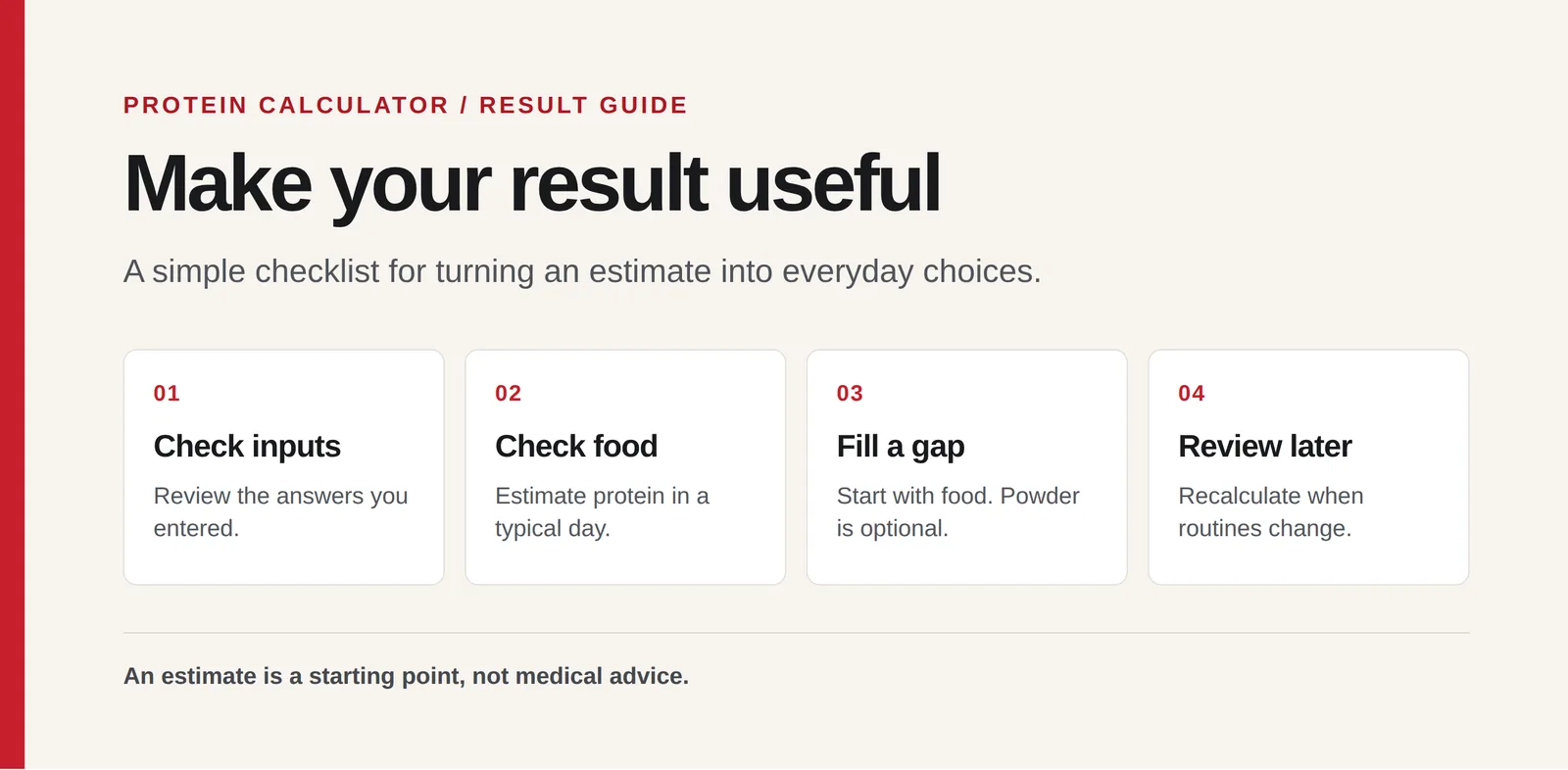
Read the protein result as grams of protein per day. That means protein from all your meals, snacks and any supplements combined. It does not mean the weight of the food on your plate or the weight of powder in a scoop.
| Result | What it means | How to use it |
|---|---|---|
| Protein | An estimated daily amount in grams | Compare it with protein from your usual food and drinks. |
| Carbohydrates | An estimated daily amount in grams | Consider it alongside the rest of your eating pattern. |
| Fat | An estimated daily amount in grams | Treat it as a guide, not a reason to exclude fats. |
| Calories | A separate goal-based calorie estimate | Do not assume it matches the calories implied by the macro figures. |
The current widget says its protein, carbohydrate and fat figures are averages and do not represent the displayed goal-based calorie count. Treat the two sets of figures separately. A dietitian can help if you need a coordinated nutrition plan.
Compare the estimate with a typical day
Think through breakfast, lunch, dinner, snacks and drinks. Use food labels or a reliable food database to estimate protein in the portions you actually eat. For homemade dishes, ingredients and portion sizes can change the total.
For example, imagine an estimate of 100 g of protein and a typical day supplying 80 g. The difference is 20 g for planning purposes. These are illustrative numbers, not a result from this widget or a target for you.
If a gap appears regularly, consider a food you enjoy or a supplement that fits your routine. If the estimate seems unrealistic or conflicts with professional advice, do not force your diet to match it. Ask a registered dietitian for help.
What affects protein needs?
Several factors can matter. The calculator asks about some of them. On the result screen, protein is body weight in kilograms multiplied by 2. The notes below give general context for protein needs. They are not extra inputs in this widget.
Body size and activity
Body weight is one common starting point for protein estimates. Your usual movement and training also provide useful context. Describe your routine honestly, including less active days.
Training and goals
Someone who trains regularly may have different needs from someone who rarely exercises. Muscle gain, maintenance and weight change also involve more than protein alone. Training, total food intake, rest and individual circumstances all matter.
Age and health
Needs can change with age and life stage. Illness, treatment, pregnancy and breastfeeding can also change the advice a person needs. A general fitness calculator cannot assess these circumstances.
Eating pattern
Diet preferences affect how you might reach an estimate, even when two people see a similar number. Meals built around beans, dairy, fish, meat or plant-based alternatives can all contribute protein. The right choice also depends on tolerances, budget and preference.
How is this different from a grams-per-kilogram rule?
A simple per-kilogram rule multiplies body weight by one chosen protein figure. The American Heart Association gives an adult reference of 0.8 g per kilogram per day. Its example is 56 g for a 70 kg adult. This is a general reference, not a personal prescription or this widget’s formula.
The International Society of Sports Nutrition’s position stand describes 1.4–2.0 g per kilogram per day as sufficient for most healthy exercising individuals. It is a broad sports-nutrition range, not a promise or a suitable target for everyone.
The Muscle Plus widget asks for a name, gender, an age range, height in centimetres, weight in kilograms, a goal and up to two health and fitness goals. The daily-activity and weekly-exercise slides are turned off in the widget, so the script uses the moderate factor for both. Age is the midpoint of the selected range: 21.5 for 18–25, 30.5 for 26–35, 43 for 36–50 and 55 for 51+. Basal energy is 88.362 + 13.397 × weight in kg + 4.799 × height in cm − 5.677 × age for male, and 447.593 + 9.247 × weight in kg + 3.098 × height in cm − 4.33 × age for female. That figure is multiplied by 1.55 × 1.2. For a gain goal, 500 kcal is added and the calorie pair runs from that total to 250 kcal above it. For a lose goal, 500 kcal is subtracted and the calorie pair runs from 250 kcal below that total up to it. For maintain, the calorie pair runs from 250 kcal below the unadjusted total to 250 kcal above it. Protein is shown as weight in kg × 2 grams on both ends. Carbohydrate is weight × 3 grams and fat is weight × 0.8 grams, the same on both ends. The script also sets protein factors of 1.8 and 2.2 for gain or lose, and 1.6 and 2.0 otherwise, and does not use them for the protein figure. The name and the health-goal choices do not change these numbers.
For a fuller explanation of protein ranges and sources, read how much protein per day. Use this page to run the existing calculator and make sense of its result.
Food or protein powder: which should you choose?
Start by looking at the food you already eat. Many people can meet their protein needs through a varied diet. The sports-nutrition position stand notes that physically active people can obtain their daily protein from whole foods; supplements can be a practical option.
In Lebanon, a typical day might include eggs, labneh or yogurt, chicken or fish, lentils, chickpeas or foul. Hummus and lentil dishes can contribute protein too. The amount depends on the recipe and serving size, so check the portion rather than assuming a fixed number.
Examples of protein in food
These examples can help you picture a portion. They are not calculator results or personal targets.
| Food | Example portion | Approximate protein |
|---|---|---|
| Plain cooked lentils | 1 US cup | 18 g, according to Harvard’s Nutrition Source |
| Milk | 8 US fluid ounces, about 237 mL | 8 g, according to the American Heart Association |
The amounts are approximate. A cup of lentil soup is not necessarily the same as a cup of plain cooked lentils. For packaged milk or mixed dishes, check the label or ingredients and the portion you actually use.
When a powder may be convenient
A powder can be useful when food alone does not fit your schedule or preferences. It is not required for exercise, and it does not replace a varied diet. You can compare food and powder using your own routine, budget and dietary needs.
Read the full label rather than relying on the product name. Before choosing a product, check:
- Protein per serving: Look for protein grams on the nutrition panel. Scoop weight and protein content are not necessarily the same.
- Serving size and directions: Compare products using their stated serving sizes and follow the current pack.
- Ingredients and allergens: Check milk, lactose, sweeteners and other ingredients where relevant to you.
- Pack details: Review the expiry date, seal and seller information. Ask the seller if anything is unclear.
Browse the protein powders collection to compare current options and labels. Muscle Plus describes itself as the official and exclusive Scitec Nutrition agent in Lebanon. This is a commercial page, and the collection link leads to Muscle Plus products.
Limits and when to ask a professional
This calculator provides general fitness information. It is not medical advice, a diagnosis or a treatment plan. It cannot account for every medical condition, medication, laboratory result or nutritional need.
If you have a health condition, take medication, are pregnant or breastfeeding, or are under 18, speak with a qualified healthcare professional or registered dietitian before relying on the result. Do the same if you have an eating disorder or concerns about restrictive eating.
For example, the US National Institute of Diabetes and Digestive and Kidney Diseases recommends individual guidance for people with chronic kidney disease. Do not replace an existing medical nutrition plan with a calculator result.
Frequently asked questions
How much protein per day does this calculator estimate?
It gives an estimated daily amount in grams after you complete the questions. Your needs may differ, so use the result as a starting point rather than a prescription.
Do I need protein powder to meet my estimate?
No. Food can often supply the protein you need. A powder is optional and may be convenient if it suits your diet and circumstances.
Why is my result different from a grams-per-kilogram rule?
A simple rule uses body weight and a chosen multiplier. This widget shows protein as 2 grams per kilogram of body weight, so it can differ from a 0.8 g or a 1.4–2.0 g reference. The calorie figures are calculated separately and are not produced by multiplying the protein figure.
Can I use the calculator for muscle gain or weight change?
You can select a goal in the widget and use the result as a general estimate. Protein is only one part of your eating and training routine. The result does not promise a change in muscle or body fat.
Do the macro results add up to the calorie estimate?
Not necessarily. The widget says its protein, carbohydrate and fat figures are averages that do not represent the displayed goal-based calorie count. Do not assume the two sets of figures match.
Can I rely on the result if I have a health condition?
No calculator can provide individual medical advice. If you have a health condition, speak with a qualified healthcare professional or registered dietitian before relying on the result.
Do I have to provide an email address to see my result?
No. Sending the result by email is optional. You can read the result without requesting an email.
When should I use the calculator again?
Consider repeating it when your weight, usual activity or training goals change. A new estimate is still a starting point, not a medical assessment.
References
- American Heart Association: Protein: What’s Enough?
- Harvard’s Nutrition Source: Protein
- International Society of Sports Nutrition position stand: protein and exercise
- NIDDK: Healthy Eating for Adults with Chronic Kidney Disease
Last reviewed: November 11, 2026.