
If you are searching for “mass gainer Lebanon,” start with the calories and protein you need. Then check the serving size, ingredients and cost of the portion you will actually use. A gainer is a convenient food supplement, not a shortcut to muscle gain. The right choice fits your diet, tolerance and budget.
This guide is about choosing a product, not ranking tubs. For the broader decision about whether a gainer fits your plan, read when to use a mass gainer and the clean versus dirty bulk comparison.
Last reviewed: November 11, 2026.
Commercial disclosure: This is a Muscle Plus shopping guide and links to its store. Muscle Plus describes itself as the official and exclusive Scitec Nutrition agent in Lebanon. The relationship does not make any product right for everyone.
Start with a mass-gainer buying checklist
Before you compare tubs, write down the job you need the product to do. A high-calorie serving is useful only if you can use that amount comfortably and it fits your usual food intake.
- Estimate your daily food intake and identify the calorie and protein gaps you want to fill.
- Decide how much powder you might actually use, not just the maximum on the front of the pack.
- Check the full label for serving weight, calories, protein, carbohydrates, fat and ingredients.
- Screen for allergens, ingredients you avoid and preparation directions.
- Compare the cost of your chosen portion, then check delivery and the total at checkout.
- Confirm the current flavour, pack size, label, expiry and availability before ordering.
If the gap is unclear, track your usual meals for a few days first. Estimates are a starting point, not a diagnosis or a promise of results.
Choose between a mass gainer, protein powder and food
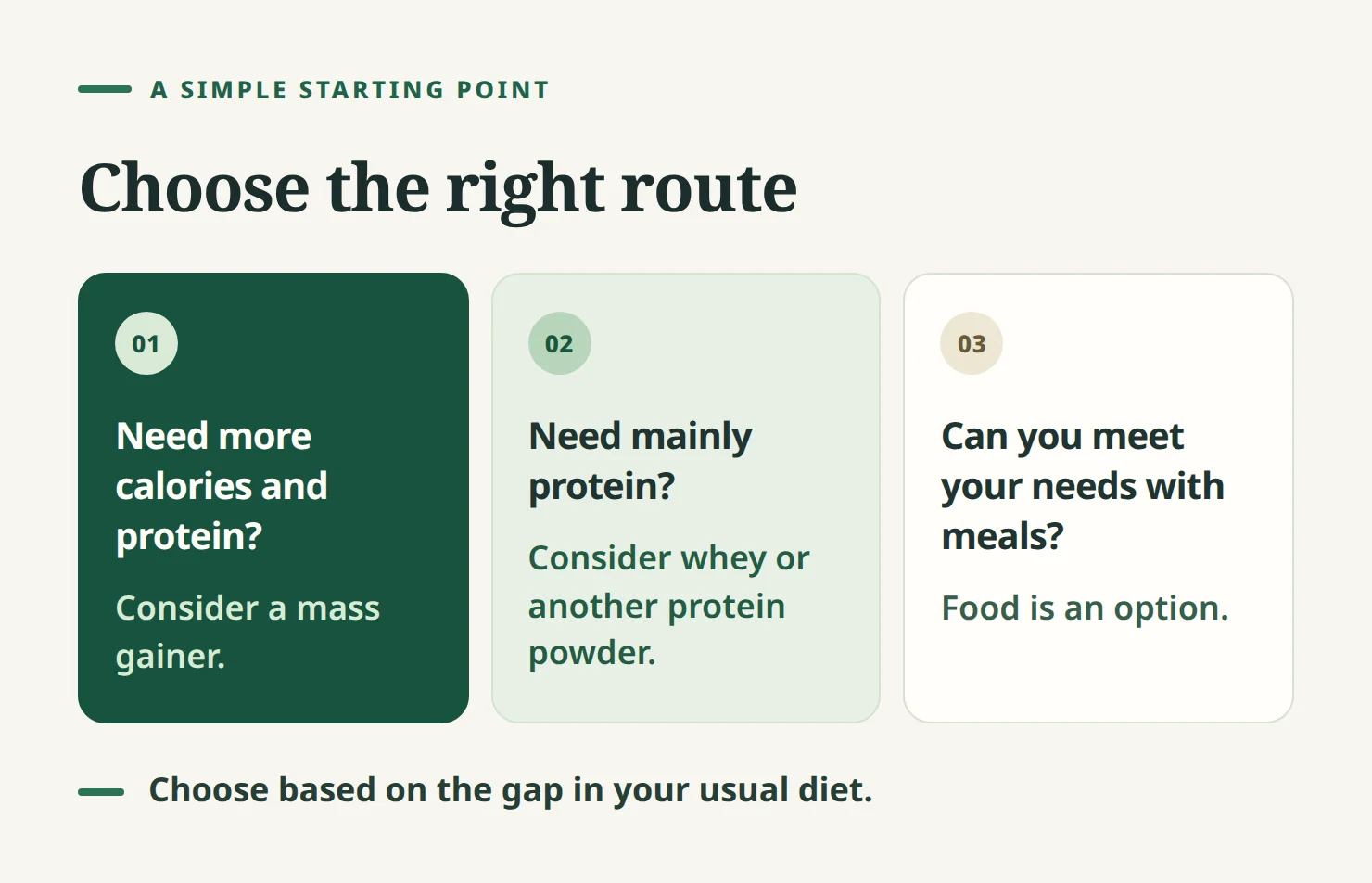
A mass gainer typically combines protein with a substantial source of carbohydrate. Formulas vary, so the label matters more than the category name. Whey and other protein powders usually focus more on protein, although their labels also vary.
| Your practical need | Option to consider | What to check |
|---|---|---|
| You need more calories and protein, and a shake would be convenient. | A mass gainer. | Does the portion fill your gap without adding far more energy than intended? |
| You mainly need protein and already have enough calories. | Whey or another protein powder. | Compare protein per actual portion, ingredients and any allergens. |
| You can meet your needs through meals and snacks. | Food, with no supplement required. | Consider cost, preparation time, variety and what you can consistently eat. |
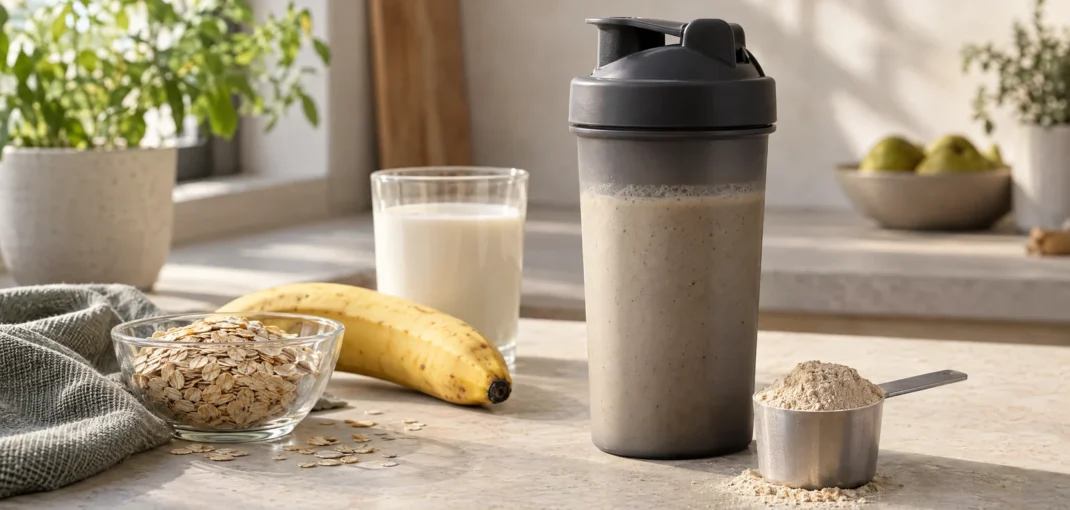
A homemade drink is another option. Milk or a suitable alternative, oats, banana and tahini can provide energy, depending on the amounts used. Check for allergies and count the ingredients if you are tracking intake.
The NHS guide to healthy ways to gain weight suggests gradual changes and balanced meals. A shake should supplement your food plan, not routinely displace meals.
Decide how many calories and how much protein you need
Start with the gap, not the largest serving
Look at your usual meals and snacks alongside your training and weight trend. A large shake can add much more energy than you intended. If your needs are uncertain, a registered dietitian can help you estimate an appropriate target.
For a worked-out discussion of calorie gaps and tracking, use our guide to when a mass gainer makes sense. This page stays focused on choosing the product and portion.
Count protein across the whole day
The International Society of Sports Nutrition position stand describes 1.4–2.0 g of protein per kilogram of body weight per day as sufficient for most healthy exercising people. This is a general range, not an individual prescription.
For illustration, at 70 kg that range is 98–140 g of protein per day. Count protein from meals, snacks and any shake together. People with medical conditions or special dietary needs should seek individual advice instead of applying the range automatically.
Use the protein calculator as a starting point. If you mainly need protein, compare the protein-powder collection as well.
How to read a mass-gainer label
Start with the weight of one serving in grams. Then check whether the figures describe dry powder, a prepared drink, 100 g, or another basis. Label layouts vary, so read the headings carefully.
The US FDA’s serving-size explanation shows why the portion and the figures must be read together. It describes US food labels; labels sold in Lebanon may use a different format.
Scale the label to your actual portion
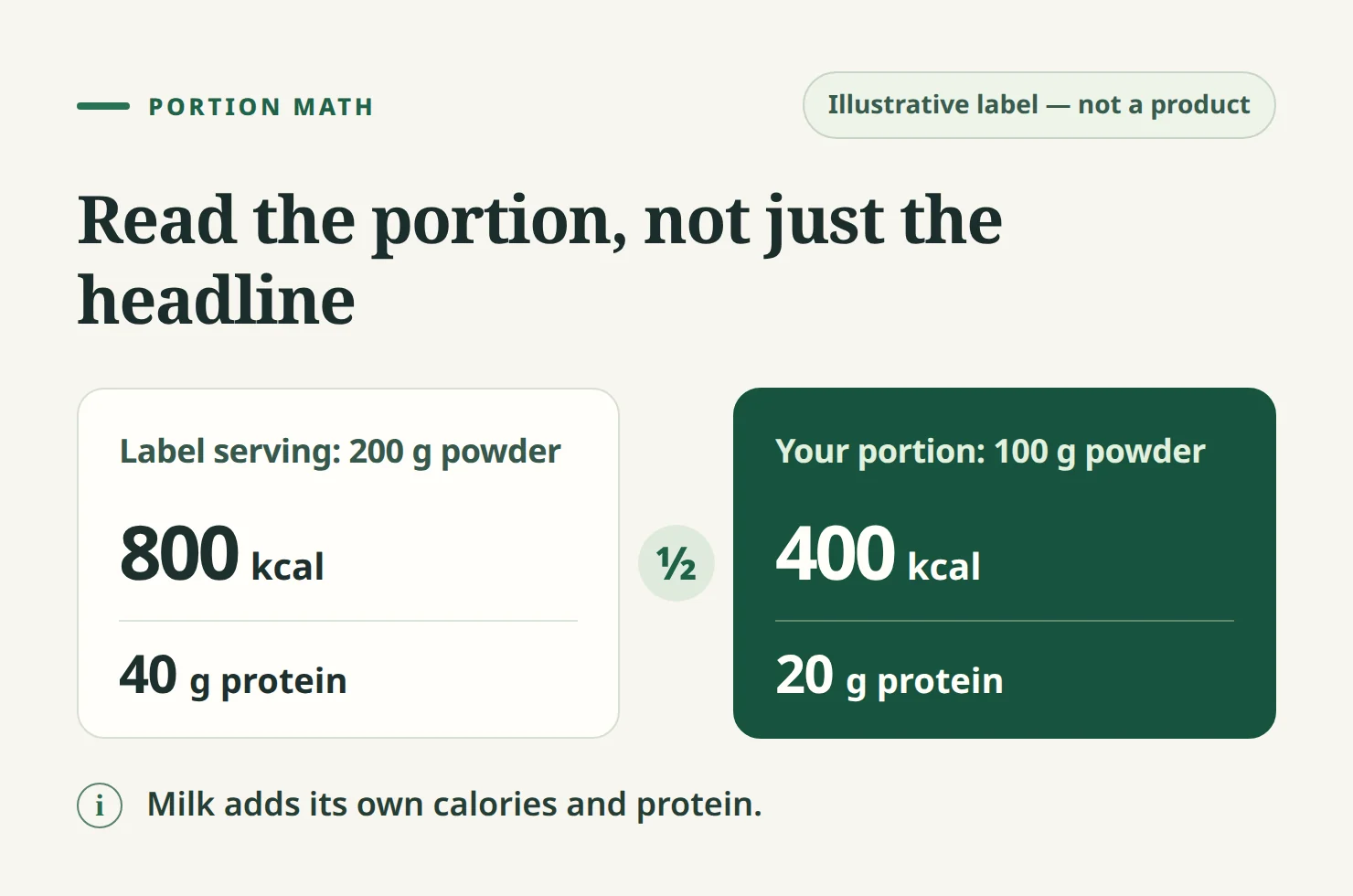
The following is a fictional example, not a product or a recommended serving. It assumes the label figures are for dry powder and the ingredients are evenly mixed.
| Powder portion | Calories from powder | Protein from powder |
|---|---|---|
| Full labelled serving: 200 g | 800 kcal | 40 g |
| Half that serving: 100 g | 400 kcal | 20 g |
| Quarter of that serving: 50 g | 200 kcal | 10 g |
To calculate your portion, divide the grams you will use by the labelled serving grams. Multiply each per-serving figure by that fraction. A kitchen scale is more reliable than assuming every scoop holds the same weight.
For example, 100 g ÷ 200 g = 0.5. Multiply the label’s calories and protein by 0.5. Follow the actual pack’s directions; ask the seller or a qualified professional if they are unclear.
Separate powder from the finished drink
Water adds no calories. Milk, juice or other additions have their own calories and nutrients. Add those separately unless the label already includes them in its prepared-drink figures.
A shake mixed with milk may also contain more dairy allergens or lactose. Check the powder and the liquid separately. Do not compare a powder-only figure with another product’s milk-prepared figure as if they were the same thing.
Compare calories, protein and carbohydrates fairly
Put both products on the same basis
Compare products per 100 g of dry powder, then compare the actual portion you expect to use. If only a per-serving figure is shown, divide it by serving grams and multiply by 100.
For the fictional label above, 800 kcal ÷ 200 g × 100 = 400 kcal per 100 g. The same calculation gives 20 g protein per 100 g. These numbers illustrate the method; they do not describe a product in the store.
Per-100-g comparisons show concentration. Your actual-portion comparison shows what you will consume. Neither number alone tells you whether a product is suitable or worth buying.
Look past the calorie headline
Check protein, total carbohydrate, sugars and fat for the same portion. A higher carbohydrate figure is not automatically a problem, but it should fit your needs. Total carbohydrate is not the same as sugar, and a low-sugar claim does not mean carbohydrate-free.
A high protein figure on a large serving can be misleading. Compare it with the protein you need and the grams of powder required. Do not assume one brand’s scoops or ratios match another’s.
Check ingredients, allergens and tolerance
Protein and carbohydrate sources
Read the ingredient list as well as the nutrition panel. A formula may contain milk proteins, soy or other ingredients. Carbohydrate sources can include ingredients such as maltodextrin or oat flour; the actual formula determines what is present.
The ingredient list helps you see what you are buying. It does not tell you that a product is right for your medical condition. If a key ingredient or its amount is unclear, ask for the current label before ordering.
Lactose, allergies and dietary preferences
Milk protein allergy and lactose intolerance are different. A product described as low in lactose is not necessarily safe for someone with a milk allergy. Check allergen warnings on both the powder and anything mixed into it.
If you avoid dairy, soy, gluten or animal ingredients, check the exact pack and flavour. Do not assume every option in a range shares the same formula. For an allergy, ask a qualified clinician about suitability and cross-contact risks.
Sweeteners and added ingredients
Flavours may contain sweeteners, thickeners or added fibre. Some formulas also add creatine or other active ingredients. Check the quantity per actual portion and avoid unintentionally doubling ingredients across supplements.
If you already take creatine, read the creatine buying guide and compare both labels. A blend that does not disclose an ingredient’s amount cannot be assessed as if the amount were known.
Compare two live Scitec labels
These are examples of how to compare labels, not a ranking. Muscle Plus displayed these figures on the linked product pages on November 11, 2026. Check the selected flavour, current label and price before buying; formulations and listings can change.
| Product and listed pack | Labelled serving | Figures per 100 g of powder |
|---|---|---|
| Jumbo Hardcore!: 3,060 g, US$125 | 153 g: 581 kcal, 63 g protein, 65 g carbohydrate and 3 g creatine | 379 kcal, 41 g protein and 42 g carbohydrate |
| MyoMax Hardcore: 2,800 g, US$120 | 140 g: 511 kcal, 56 g protein, 64 g carbohydrate and 3 g creatine | 365 kcal, 40 g protein and 46 g carbohydrate |
The labelled servings are different weights. The per-100-g figures come from the product-page panels; rounding can make them differ slightly from a calculation using per-serving figures. Both listings include creatine, so check for overlap if you already use it separately.
Using the listed pack prices, 100 g of powder works out to approximately US$4.08 for Jumbo and US$4.29 for MyoMax. These are calculated snapshots, before any delivery charge. They are not current-price or availability promises.
Both listings identify milk ingredients. Jumbo’s listing describes a lactose-free threshold for the prepared drink; that does not mean milk-protein-free. Check the exact flavour’s ingredients and allergen information, not just the product name.
How to compare mass-gainer value in Lebanon
Calculate the cost of the portion you will use
A large tub or a low headline price is not automatically the better value. Compare the same currency, the same dry-powder weight and a realistic portion. Use the current product page for each price.
- Record the current pack price and net weight in grams.
- Divide the pack price by the net weight. This gives the price per gram.
- Multiply that result by the grams in your planned portion. This gives the powder cost per portion.
- Divide the net pack weight by your planned portion grams. This estimates how many such portions the pack contains.
- Check the calories and protein delivered by that same portion. A cheaper portion may not deliver the same amounts.
For a broader comparison, calculate price per 100 g: price ÷ pack grams × 100. Per-100-g value compares powder weight, not protein quality or nutritional suitability. Round only at the end.
You can also compare price per 10 g of protein: portion cost ÷ portion protein in grams × 10. For price per 1,000 kcal, use portion cost ÷ portion calories × 1,000. Use the same dry-powder basis and never divide by zero.
Include the real order total
Check whether the displayed amount applies to the size and flavour you selected. Confirm the currency, payment terms, delivery charge and final total at checkout. If a different currency is offered, confirm the conversion used before comparing.
Prices, variants and availability can change. The comparison above is a dated snapshot, not a stock or checkout promise. The current product page and checkout take priority.
Check the seller and pack before using it
Start with the exact product name, flavour and net weight. Review the full ingredient panel, directions, expiry date and batch or lot information. Ask for a clear label image if the online details are incomplete.
When the order arrives, compare the pack with what you ordered. Check that the tamper seal and packaging appear intact. An intact seal or batch code alone cannot prove authenticity; raise concerns with the seller before opening or using the product.
Keep the order details and ask about the return process if the pack differs from the listing. Do not assume a product is genuine solely because of a logo, a low price or a claim in an advert.
For questions about local product permissions, ask Lebanon’s Ministry of Public Health about the exact item. An online list or a seller’s statement alone does not verify the current status or authenticity of a particular pack.
If you compete in tested sport
Ask whether the exact product and, where applicable, the batch have independent certification for prohibited substances. Check directly with the certification programme rather than relying on an image of a badge.
USADA’s supplement-risk guidance explains how to check a certified product and lot. Certification reduces risk; it does not make a supplement risk-free or suitable for every person. This guide does not claim that any Muscle Plus product holds a certification.
Prepare and use the product sensibly
Follow the current pack’s mixing, serving and storage instructions. Check whether you can use a smaller portion under those directions. A partial portion still contributes calories and protein; calculate both rather than treating it as a full serving.
Choose a time that fits your meals and routine. A shake is not mandatory immediately after training. Keep your overall diet and training consistent, and adjust your plan with a qualified professional if needed.
If a product causes discomfort, stop using it and review the ingredients. Seek professional advice for persistent symptoms or a suspected intolerance. For a suspected serious allergic reaction, seek urgent medical help.
Who should seek individual advice before buying?
Talk to a qualified clinician or dietitian first if you have diabetes, kidney disease, digestive conditions or food allergies. The same applies if you take medication, are pregnant or breastfeeding, are under 18, or have a history of disordered eating.
Unexpected weight loss needs medical attention rather than an automatic supplement purchase. The NHS advice on unintentional weight loss explains why it should be checked. This guide is educational and is not personal medical advice.
Frequently asked questions
How do I choose a mass gainer in Lebanon?
Identify your calorie and protein gap first. Then compare serving weight, the nutrition in your actual portion, ingredients, allergens, current pack value and seller information. Confirm the label and availability before ordering.
Is a mass gainer better than whey protein?
Neither is universally better. A mass gainer may suit someone who needs convenient calories and protein. Whey may suit someone who mainly needs protein. Compare the actual labels and your diet.
Do I need the full serving on the tub?
Not necessarily. A smaller amount may fit your needs, provided it is consistent with the pack’s directions. Calculate calories and protein for the amount you actually use.
Can I mix a mass gainer with milk instead of water?
Check the product directions and your tolerance. Milk adds its own calories and protein unless the label’s prepared-drink figures already include it. Milk also matters for people avoiding dairy or lactose.
How can I compare two tubs with different serving sizes?
Compare their dry-powder nutrition per 100 g, then calculate the values for the portion you expect to use. Use the same preparation basis and check cost, ingredients and allergens too.
Is a mass gainer suitable if I am lactose intolerant?
Not automatically. Formulas differ, and milk-based ingredients may contain lactose. Check the exact label and ask a clinician or dietitian if you are unsure. Lactose intolerance is not the same as milk allergy.
Will a mass gainer make me gain only muscle?
No. A gainer supplies nutrients and calories, but it cannot promise muscle gain or prevent fat gain. Training, your overall diet, recovery and individual circumstances all matter.
How do I check whether a product is genuine?
Buy from a seller you can contact, compare the received pack with your order, and check the seal, lot information and expiry. These checks are useful but do not prove authenticity. Ask the seller about any concern before use.
Can beginners or teenagers use a mass gainer?
Beginners do not automatically need one. Compare it with food and protein powder based on your needs. Anyone under 18 should seek individual advice from a qualified healthcare professional before using a supplement.
How much does a mass gainer cost in Lebanon?
Prices vary by product, size, flavour and seller. Check the current product page and final checkout total. Compare the cost of the portion you will actually use rather than tub price alone.
Compare current weight-gain options
Use your checklist to browse the mass-gainer and weight-gain supplement collection. Open the current product pages for the exact label, options, price and availability before ordering.
You can also explore the related weight-gain goal page. If you are still deciding whether you need a gainer at all, return to the when-to-use guide.