
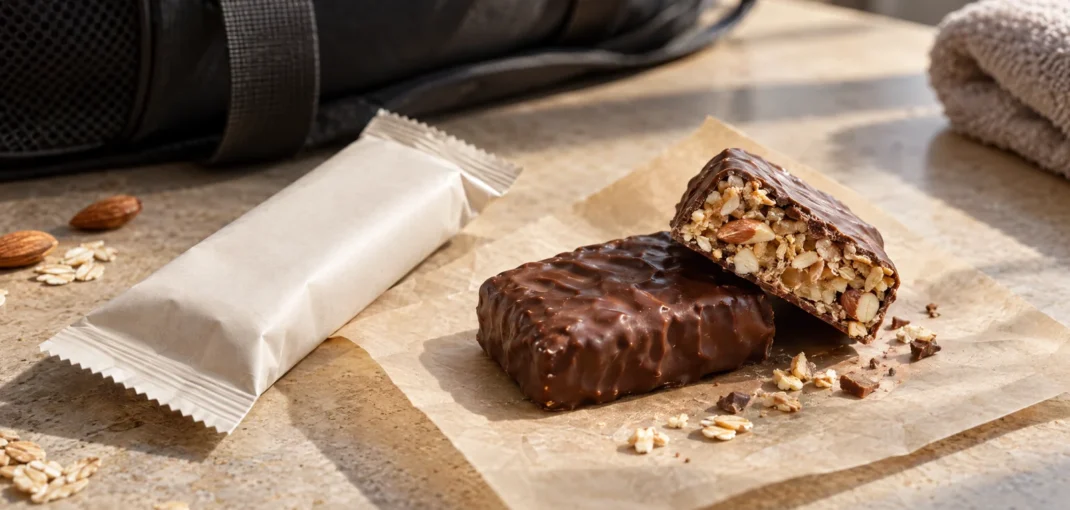
Shopping for protein bars in Lebanon? Choose Choco Pro or Proteinissimo when you want a portable protein snack. Their published panels list roughly 14–16 g of protein per 50 g bar. Choose Oat Bar for an oat-based carbohydrate snack instead. Check the flavour’s label, allergens and current price before ordering.
Muscle Plus describes itself as the official and exclusive Scitec Nutrition agent in Lebanon. This guide explains the differences between its listed bars and everyday alternatives. The figures below are examples from published panels, not a substitute for the pack in your hand.
A Quick Purchase Checklist for Protein Bars in Lebanon
Start with the reason you want a snack. A bar for an extra protein portion is different from an oat snack for carbohydrate. Neither needs to replace a meal.
- Choose the job. For protein, compare Choco Pro and Proteinissimo. For an oat-based snack with more carbohydrate, look at Oat Bar.
- Check the serving. Is the panel for one bar, 100 g or several pieces? Calculate the amount you will actually eat.
- Check protein and energy together. Compare grams per bar as well as calories. Use protein per 100 kcal when that comparison suits your goal.
- Read the rest of the panel. Look at sugar, fibre, carbohydrate, fat and any listed polyols. Decide which details matter to you.
- Read the ingredients and allergy advice. Check the specific flavour, including milk, soy, nuts and gluten where relevant.
- Check the purchase details. Confirm the bar count, flavour, currency, current price, availability, delivery terms and expiry on the relevant page or with the store.
- Check storage. Follow the pack’s instructions, especially during travel or hot weather.
Ready to compare? Browse the protein bars and meals and snacks category or open Choco Pro Bar, Proteinissimo Bar and Oat Bar individually.
Why High-Protein Snacks Can Help on Busy Days
Use a snack to bridge a gap
A planned snack can help when a meal is delayed, during a commute or between work and training. It can also add protein to a day when your meals fall short of your needs. You do not need to eat at a fixed interval for a snack to be useful.
A review of protein and appetite studies found that protein reduced reported hunger and increased fullness in short-term comparisons. Those findings do not predict how full one particular bar will make you. Appetite, portion size and the rest of the meal vary.
Put the bar in the context of your day
The European Food Safety Authority gives a population reference intake of 0.83 g of protein per kilogram of body weight per day for healthy adults. This is not a ceiling or a personalised exercise target. Needs vary with age, activity, health and other circumstances.
The International Society of Sports Nutrition suggests about 1.4–2.0 g/kg/day for most exercising people. That is sports guidance, not a prescription for everyone. Our guide to how much protein per day explains how to think about your daily total.
Food can provide the protein you need. A bar is a convenient option when it fits your schedule and preferences. It is not essential if your meals and other snacks already meet your needs.
How to Read a Protein Bar Label in 60 Seconds
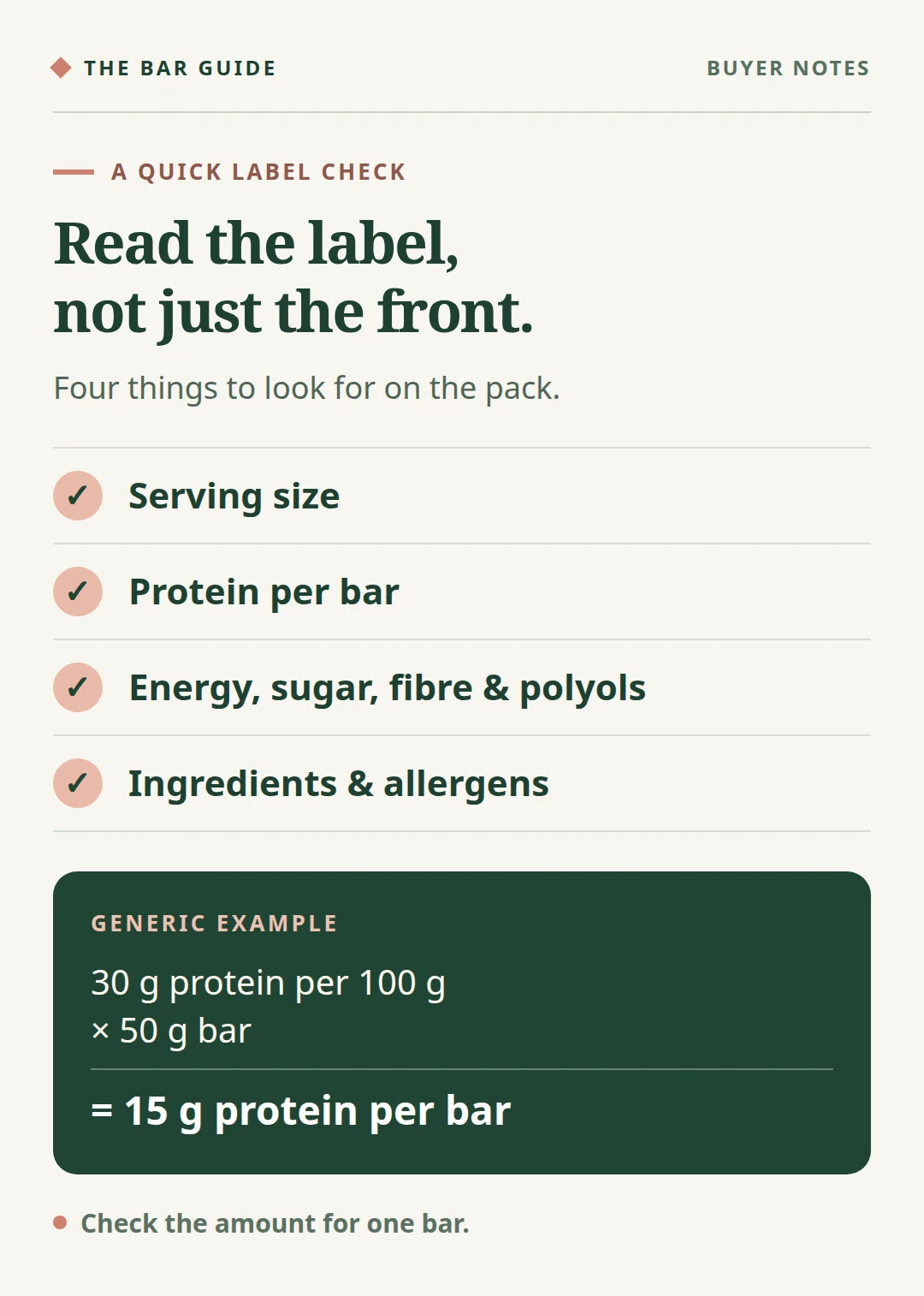
Start with the back of the pack rather than the product name. Read the serving size first, then compare the nutrition panel and ingredients. The FDA label guide explains why the serving matters.
1. Convert the figures to one bar
Some panels give values per 100 g, while others show a bar or another serving. Multiply the per-100-g figure by the bar weight in grams, then divide by 100.
For example, a 50 g bar with 30 g protein per 100 g provides 15 g protein per bar. A 70 g bar would use 0.7 of the per-100-g figure. Apply the same calculation to calories, sugar and fibre.
If a box contains several bars, check the weight and count separately. Do not assume the box is one serving. If the online panel is unclear, ask for the specific flavour’s label before ordering.
2. Compare protein per bar and per 100 kcal
Protein per bar tells you how much the snack adds to your day. Protein per 100 kcal shows how concentrated that protein is relative to energy. Neither number answers every shopping question.
Calculate it as protein grams ÷ calories × 100. A bar with 15 g protein and 182.5 kcal provides about 8.2 g protein per 100 kcal. A larger or more energy-dense snack may still suit someone who wants more fuel.
Do not compare nutrition per 100 g on one product with nutrition per bar on another. Put both in the same units first. Then look at the ingredients, taste, tolerance and cost as well.
3. Understand the high-protein claim
Under EU nutrition-claim rules, a food labelled “high protein” must get at least 20% of its energy from protein. That is a share of calories, not 20% of the bar’s weight. The EU rule should not be treated as a statement of Lebanese law.
As a rough check, multiply protein grams by four, then divide by the calories. Multiply by 100 to get the approximate percentage of energy from protein. This arithmetic is useful for comparing labels; it is not a full legal assessment.
4. Look at sugar, fibre and polyols
Check the amount of sugar in the portion you plan to eat. Total sugar does not always tell you how much was added. The World Health Organization distinguishes free sugars from sugars naturally present in milk and intact fruit.
Fibre can be useful as part of an overall diet, but a high number is not essential for every snack. Some bars contain added fibres or sweeteners that some people find uncomfortable. If you are sensitive, start with a smaller portion and see how you tolerate it.
Polyols, also called sugar alcohols, include maltitol and sorbitol. They can have a laxative effect when consumed in excess. Under EU labelling rules, foods with more than 10% added polyols require a warning. This is an EU rule, not a verified Lebanese requirement. A separate polyol quantity may not appear on every panel.
5. Read protein sources and allergens
Milk and whey proteins provide all the indispensable amino acids. Collagen is not a complete protein on its own. Some bars mix these sources; the ingredient list does not tell you the exact proportion of each.
A 2025 study examined a database of bar labels and tested four selected bars in simulated digestion. It does not establish how much protein a person absorbs from a particular bar. Use the label to compare ingredients, not to calculate a claimed absorption rate.
Look for milk, soy, nuts, peanuts, eggs, wheat or other ingredients relevant to you. Whey is a milk protein, and milk allergy is not the same as lactose intolerance. Check advisory statements too. If a severe allergy is involved and the label is unclear, contact the manufacturer or avoid the product. The FDA’s allergy-label advice explains why cross-contact matters.
Protein Bar vs Protein Shake: Which Fits Your Day?
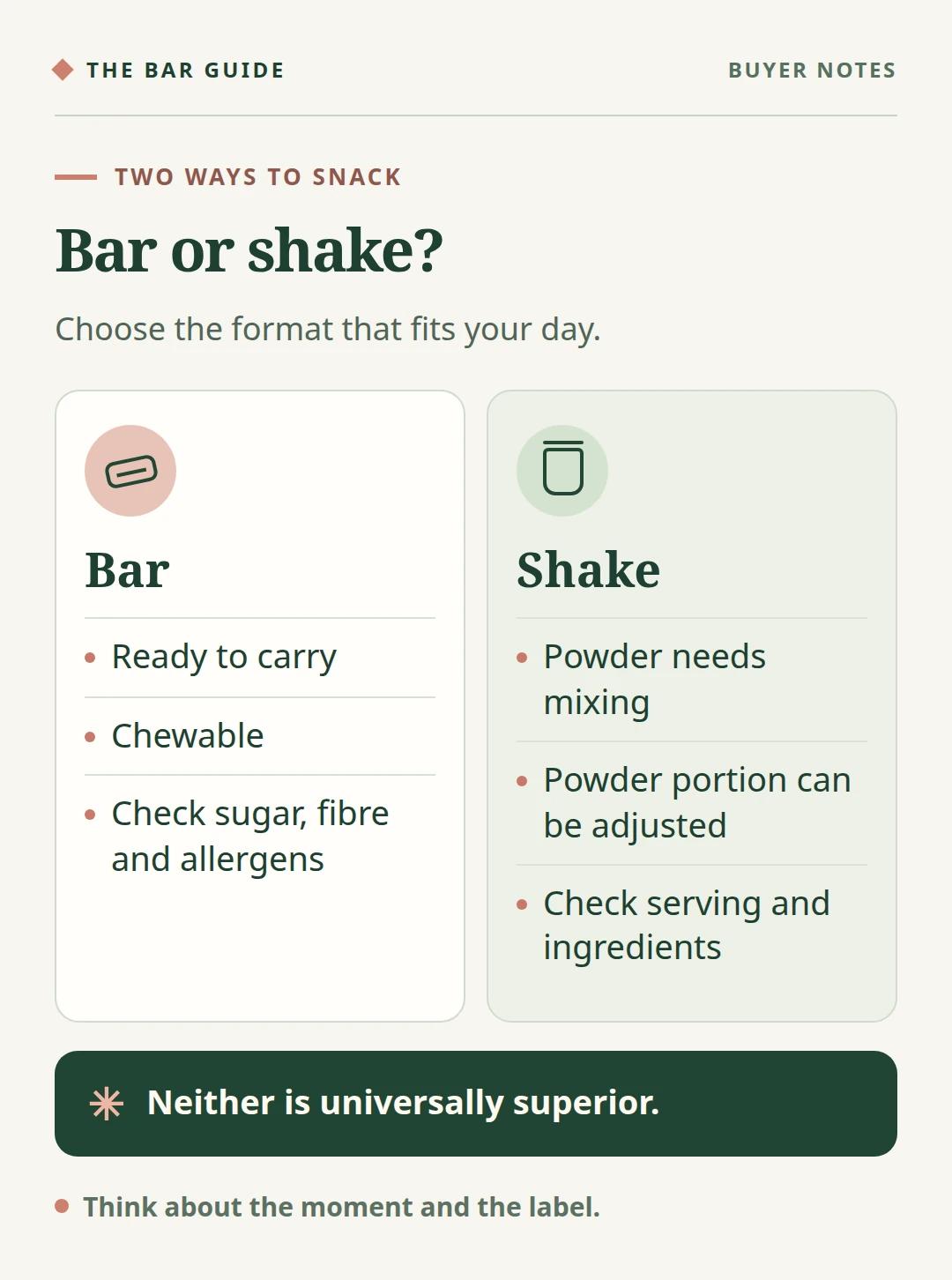
A bar is ready to eat and easy to carry. A shake can be mixed in a chosen portion. The useful comparison is between actual servings, not between all bars and all shakes.
| Consideration | Protein bar | Protein shake |
|---|---|---|
| Preparation | Usually ready to eat | Powder needs liquid and mixing; ready-to-drink options differ |
| Portion | Usually fixed by the bar | Powder portions can be adjusted using the label |
| Protein and energy | Check grams and calories per bar | Check the scoop or bottle and the liquid used |
| Other ingredients | May include fibre, sugar, polyols or a coating | May include sweeteners or other ingredients; liquids add their own nutrients |
| Practical use | Convenient when chewing and carrying matter | Convenient when you can mix or carry the prepared drink safely |
Choose a bar when carrying a snack matters
A sealed bar can be useful in a work bag or gym bag. It needs no shaker or water at the time you eat it. Check the pack’s storage instructions rather than assuming it can stay in a hot car.
If chewing and flavour matter to you, compare those too. Individual preferences differ. A bar may contain more than protein, so its energy and ingredients should fit your needs.
Choose a shake when an adjustable portion matters
A powder mixed with water lets you change the amount within its serving guidance. Milk, juice or other additions change the final drink. Check the label of both the powder and the liquid.
Some shakes offer more protein per calorie than some bars; others do not. Compare actual labels. Browse the protein powders if that format suits your day.
You do not need both
A shake and a bar are options, not a required pair. Choose one, both or neither according to your meals, appetite and routine. A prepared milk-based drink is perishable, so keep it cold as directed.
Compare Scitec Bars in Lebanon
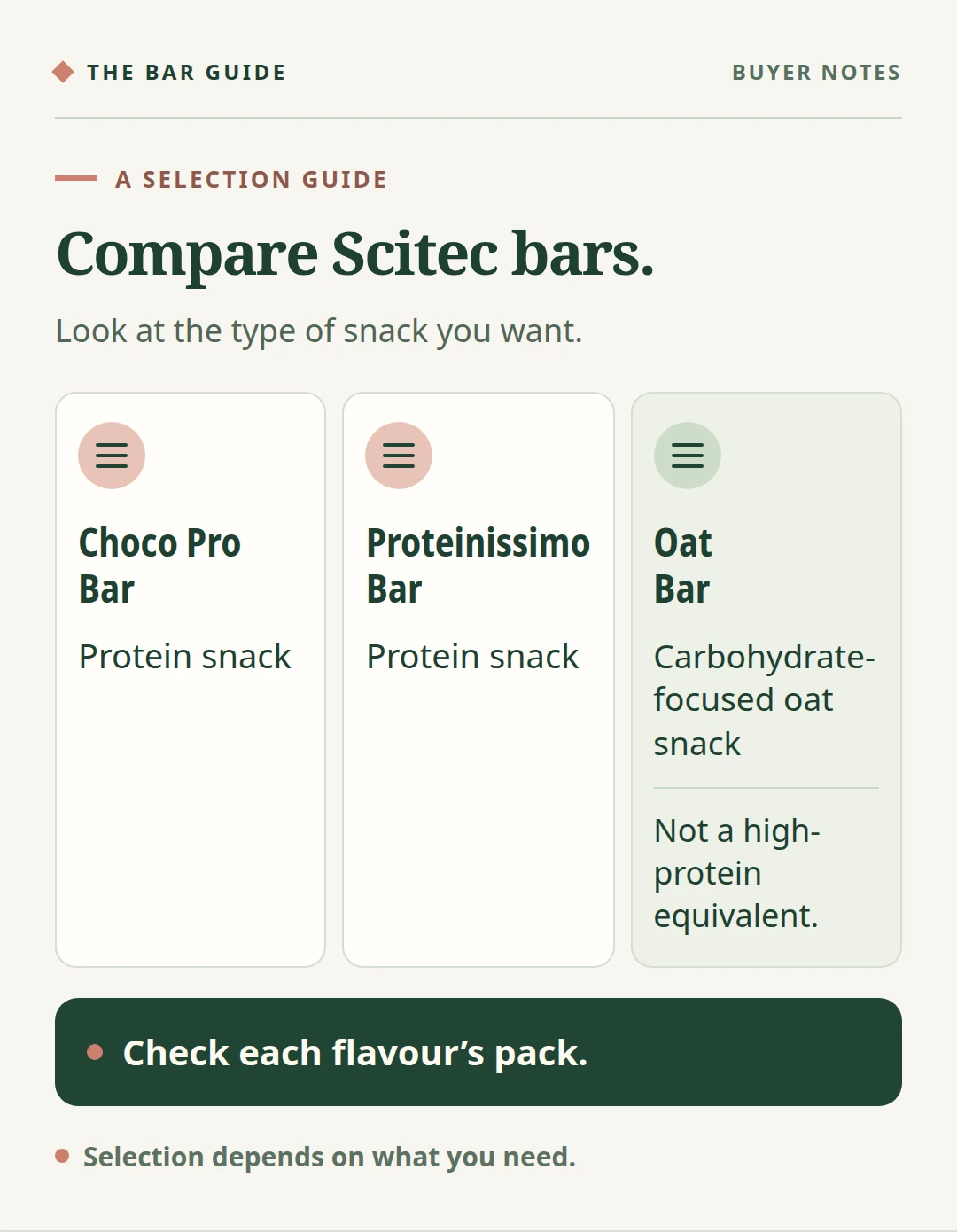
Choco Pro and Proteinissimo are protein-focused bars. Oat Bar is an oat-based snack with substantially less protein in the coconut example below. It serves a different purpose rather than acting as a direct protein equivalent.
The figures are from online product panels checked on November 11, 2026. The Choco Pro panel does not clearly identify a flavour. Proteinissimo’s one-bar figures are calculated from the per-100-g panels. Check the exact flavour and current pack before buying.
| Published product panel | Bar size | Protein per bar | Energy per bar | Protein per 100 kcal | Sugar per bar | Fibre per bar |
|---|---|---|---|---|---|---|
| Choco Pro Bar, generic panel | 50 g | 14 g | 182.5 kcal | About 7.7 g | 1.2 g | 4.1 g |
| Proteinissimo Bar, Chocolate | 50 g | 15 g | 182.5 kcal | About 8.2 g | 0.35 g | 5.5 g |
| Proteinissimo Bar, Peanut Butter | 50 g | 15.5 g | 183 kcal | About 8.5 g | 1.6 g | 4.25 g |
| Oat Bar, Coconut | 70 g | 4.48 g | 324 kcal | About 1.4 g | 19.6 g | 0.84 g |
The Scitec Proteinissimo panels show different values for Chocolate and Peanut Butter. The Scitec Oat Bar panels also vary by flavour. The coconut numbers should not be applied to every Oat Bar.
Choco Pro Bar: a 50 g protein snack
The published generic panel lists 14 g protein, 4.1 g fibre and 1.2 g sugar per bar. The manufacturer’s Choco Pro panel lists the same portion figures. Its exact nutrition may differ by flavour or reformulation.
The local page describes three animal protein sources and says the bar is palm oil free. It also lists a gluten-free claim under EU rules. Check the exact pack and current manufacturer notices if gluten avoidance is medically important.
The site lists Double Chocolate, Salted Caramel and Strawberry White Chocolate as options. The visible ingredient panels do not clearly cover every listed option. Published Double Chocolate and Salted Caramel ingredients include milk, soy and almonds. Check the chosen flavour’s full label and allergy advice, rather than assuming another flavour matches it.
Proteinissimo Bar: compare Chocolate and Peanut Butter
The local product page describes a chocolate-coated bar with a caramel-flavoured layer. It lists Chocolate and Peanut Butter in 50 g bars. The Chocolate panel gives 30 g protein and 11 g fibre per 100 g. Halving those figures gives 15 g protein and 5.5 g fibre per bar.
The manufacturer’s Peanut Butter panel gives 31 g protein and 8.5 g fibre per 100 g. That calculates to 15.5 g protein and 4.25 g fibre per bar. The flavour choice therefore matters when you compare labels.
The published ingredient lists include milk protein, collagen and soy ingredients. The Peanut Butter formula also lists barley malt extract. Both published flavour panels list polyols; the product page warns that excess consumption may have a laxative effect. Read the pack for exact allergens, cross-contact advice and current ingredients.
Oat Bar: an oat-based carbohydrate snack
The local Coconut panel lists 43.4 g carbohydrate and 4.48 g protein per 70 g bar. It can suit someone looking for a portable oat snack or extra carbohydrate. It is not the same protein choice as the two bars above.
The manufacturer lists other flavour families with different nutrition figures. The local page’s description and selector do not establish that every flavour is available now. Check the current product page, then confirm the exact pack.
The published Coconut ingredients include oats and soy. Other flavours have different ingredients and may include milk or nuts. Check the allergen advice and do not assume that an oat-based bar is gluten free.
Where to compare, enquire and check the current price
The meals and snacks page is the enquiry category for protein bars and fitness snacks. The healthy snacks category is the separate collection where the product pages sit. Both can help you compare the options.
Prices, flavours, packs and availability can change. Check the live product page for the selected item and confirm any missing details with Muscle Plus. Compare like with like: one bar with one bar, or a box with the same bar count.
For a box, divide the displayed box price by the number of bars to find the price per bar. To compare protein value, divide that price by protein grams per bar. Include delivery charges and currency only when you know the actual order terms. A lower price per gram is not useful if the ingredients or portion do not suit you.
High-Protein Snacks Beyond Bars
Shelf-stable options for a bag or desk
Bars are optional. Depending on the portion and product, you could carry:
- Roasted chickpeas or dried edamame; check the label for protein per portion.
- Nuts or seeds; they provide some protein along with fat and energy.
- Nut butter with a piece of fruit or a rice cake.
- Jerky or meat sticks; check the ingredients and sodium.
- An unopened fish pouch labelled shelf-stable; follow its storage directions.
Nuts and nut butter are not necessarily equivalent to a 14–15 g protein bar in a small portion. Read the portion size. Refrigerate a shelf-stable fish pouch after opening and follow the pack.
Fridge and lunchbox options
Greek yogurt or skyr, cottage cheese, eggs, cheese and cooked chicken or turkey can all contribute protein. Pair them with fruit, vegetables or bread if that suits the snack you want. Portions and nutrition differ, so check the food label when available.
Keep perishable foods cold. The USDA food-safety guidance recommends refrigeration at or below 4.4°C. Use an insulated bag with ice packs when carrying them.
Do not leave perishables unrefrigerated for more than two hours, or one hour above 32.2°C. Those are cumulative limits, not a reason to let food warm up. Follow the food’s storage directions and discard food left out longer.
How to Time a High-Protein Snack Around Training
Before training
A snack may help if you are hungry or have a long gap before exercise. Carbohydrate can be useful for activity, while protein contributes to your daily intake. Choose a portion that feels comfortable for you.
A fibre-rich or polyol-sweetened bar may not feel comfortable immediately before exercise. Try unfamiliar foods away from a demanding session. You do not need a bar if a suitable meal or other snack already fits your schedule.
After training
A meal, shake or bar can contribute protein after exercise. You do not need a shake simply because you have finished training. Earlier meals, the time until the next meal and your overall intake all matter.
The ISSN position on protein and exercise supports protein intake around training in the context of the whole day. Our guide to what to eat before and after the gym offers more meal ideas.
On rest days
Protein still forms part of your overall diet on a rest day. Use a snack if it helps meet your needs or makes the day easier. There is no requirement to add a bar when your usual food already does the job.
Dietary Needs, Storage and Safety
Check the exact flavour for dietary requirements
A gluten-free claim does not mean a product is milk-free, nut-free or vegan. A flavour name does not confirm a certification or the full ingredient list. Check the current pack for gluten-free, vegan or halal suitability where it matters to you.
If a certification is important, look for the relevant statement and confirm it with the manufacturer or certifier. Do not assume that all flavours share the same status. Formulas and advisory statements can change.
Keep bars and other food as directed
Check that the wrapper is intact and the date is suitable for when you plan to eat the bar. Store it according to the manufacturer’s instructions. Heat can affect coatings and product quality; avoid leaving a bar in direct sun or a hot car.
A sealed shelf-stable bar is different from a chilled yogurt or prepared shake. Do not assume an opened or perishable snack can be kept at room temperature. When in doubt, follow the pack and food-safety guidance.
Speak with a healthcare professional when appropriate
If you have a medical condition, take medication, are pregnant or nursing, or are under 18, speak with a qualified healthcare professional before using supplements. If you have kidney disease or have been advised to follow a particular diet, ask for individual guidance on protein. This guide is general information, not medical advice.
Common Mistakes When Buying Protein Bars
- Choosing by the front of the wrapper alone. Read the serving, nutrition panel and ingredients.
- Comparing different units. Convert per-100-g figures to one bar before judging portions.
- Ignoring the flavour. Two flavours of one bar can have different sugar, fibre and allergens.
- Using protein per calorie as the only test. Your energy needs, ingredients, tolerance and budget also matter.
- Assuming an oat bar is a protein bar. Check the protein per portion rather than the category name.
- Overlooking polyols or allergy advice. Check the ingredient list and warning on the exact pack.
- Treating every bar as a meal. A bar may lack the variety or amount of food you want from a meal.
- Assuming a listed option is available or certified. Check the current product page and ask the store when details are unclear.
FAQ
How much protein should a high-protein snack have?
There is no official minimum for a snack. A portion with 10–20 g can make a useful contribution to a daily total, but individual needs differ. Check protein per bar and decide how it fits with your other meals.
Are protein bars healthy?
They can fit into a balanced diet, but products differ. Check protein, energy, sugar, fibre, ingredients and allergens. A bar is a convenient food, not a substitute for a varied diet.
Can I eat a protein bar every day?
A bar can fit daily for some people. Consider what it replaces, your overall diet and how you tolerate its ingredients. If you have a medical condition or dietary restrictions, seek individual advice.
Is a protein bar better than a protein shake?
Neither is better for everyone. A bar is ready to eat; a powder shake needs mixing and allows an adjustable portion. Compare the labels and choose the format that suits your day.
Do protein bars contain sugar?
Some contain sugar, while others use polyols or other sweeteners. Check the panel and ingredients for the specific flavour. Excess polyols can have a laxative effect, and sensitivity varies.
When should I eat a high-protein snack?
Have one when it fits your appetite, schedule and overall diet. It can be useful between meals or around training. A particular clock time is not required.
Which Scitec bar has more protein in the published examples?
The published examples list 14 g for Choco Pro, 15 g for Chocolate Proteinissimo and 15.5 g for Peanut Butter Proteinissimo per 50 g bar. The Coconut Oat Bar panel lists 4.48 g per 70 g bar. Check the flavour’s current pack.
Is Oat Bar a high-protein alternative to the other two bars?
The published Coconut Oat Bar panel lists much less protein per bar than the two protein-focused examples. It is an oat-based carbohydrate snack instead. Other flavours can have different figures.
Are these bars suitable for a milk allergy or a gluten-free diet?
Suitability depends on the product and flavour. Published Choco Pro and Proteinissimo ingredients include milk proteins, while some ingredients or advisory statements involve gluten. Read the current pack and seek advice if you are unsure. A gluten-free claim does not mean milk-free.
Where can I check prices and availability in Lebanon?
Open the relevant product page and select the flavour and pack where available. Check the current price, availability and delivery terms there or ask Muscle Plus. Online options can change.
Choose Your Snack and Compare the Labels
For a protein-focused snack, start with the Choco Pro and Proteinissimo panels. For an oat-based carbohydrate snack, consider Oat Bar. Compare the exact flavour’s ingredients, portion and price before deciding.
Explore the protein bars and meals and snacks category to compare the current range.
Written by
Muscle Plus Editorial Team — Supplement Experts
The editorial team has product-category experience with protein bars, snack labels, and current shopping pages. Muscle Plus has a commercial relationship as the exclusive Scitec Nutrition agent in Lebanon. This is not an independent product review. Independent educational claims in this guide are cited to the linked authority sources.
Last reviewed: November 11, 2026