The Complete Bulking Guide: How to Gain Muscle Mass starts with a simple truth: learning how to bulk is not learning how to overeat. Productive bulking combines a manageable calorie surplus, progressive resistance training, enough protein, and consistent recovery.
The goal is to give your body enough energy to build muscle without gaining unnecessary fat. That means starting conservatively, tracking the right measurements, and changing your intake only when the trend—not a single weigh-in—shows that you need to.
Muscle Plus has served Lebanon’s fitness community since 2010 and is Lebanon’s official and exclusive Scitec Nutrition agent. This guide turns current sports-nutrition research into a practical plan for lifters in Beirut and across Lebanon.
Quick answer: To bulk effectively, estimate your maintenance calories, add a modest surplus, consume about 1.6–2.2 grams of protein per kilogram of body weight daily, train each major muscle group progressively, and monitor your weekly-average weight. Adjust calories after two consistent weeks, not after one unusual day.
What Is Bulking?
Bulking is a period in which you deliberately support muscle growth by combining resistance training with enough energy and nutrients. For many lifters, this means eating slightly more calories than they burn.
A calorie surplus can make gaining muscle easier, but it is not permission to eat without limits. A 2023 study in trained lifters found that faster weight gain mainly increased skinfold thickness rather than clearly producing greater muscle growth or strength across most outcomes. This supports a controlled approach rather than an aggressive “see-food diet” (Helms et al., 2023).
Lean Bulk vs. Dirty Bulk
A lean bulk uses a small, monitored surplus and mostly nutrient-dense foods. A dirty bulk uses a large, poorly controlled surplus, often with frequent high-calorie, low-nutrient foods. Both can increase scale weight, but they do not offer the same control over fat gain, digestion, energy, or long-term health.
| Approach | Calorie strategy | Food quality | Main advantage | Main risk |
| Lean bulk | Small, adjusted surplus | Mostly nutrient-dense foods with room for flexibility | Better control of body-fat gain | Requires patience and tracking |
| Traditional controlled bulk | Moderate surplus matched to experience | Balanced diet | Easier weight gain for many beginners | Can overshoot if intake is not reviewed |
| Dirty bulk | Large, unmonitored surplus | Frequent high-calorie convenience foods | Scale weight rises quickly | More fat gain, poorer diet quality, and a longer future cut |
A well-designed bulk does not require “perfect” eating. It requires a repeatable diet that covers protein, carbohydrates, healthy fats, fiber, fruit, vegetables, and enough total energy.
Who Should Bulk?
A bulk can make sense if you are relatively lean, want more muscle and strength, and are prepared to train consistently. It can also help a naturally light “hardgainer” who struggles to eat enough to support progress.
A dedicated surplus may not be the best first step if your primary goal is fat loss, your waist is already increasing quickly, or your training is inconsistent. Beginners and people returning after a long break can sometimes gain muscle near maintenance calories because they are highly responsive to training.
If you have diabetes, kidney disease, gastrointestinal problems, a history of disordered eating, or another medical condition affected by diet or training, seek guidance from a qualified healthcare professional before starting a bulk.
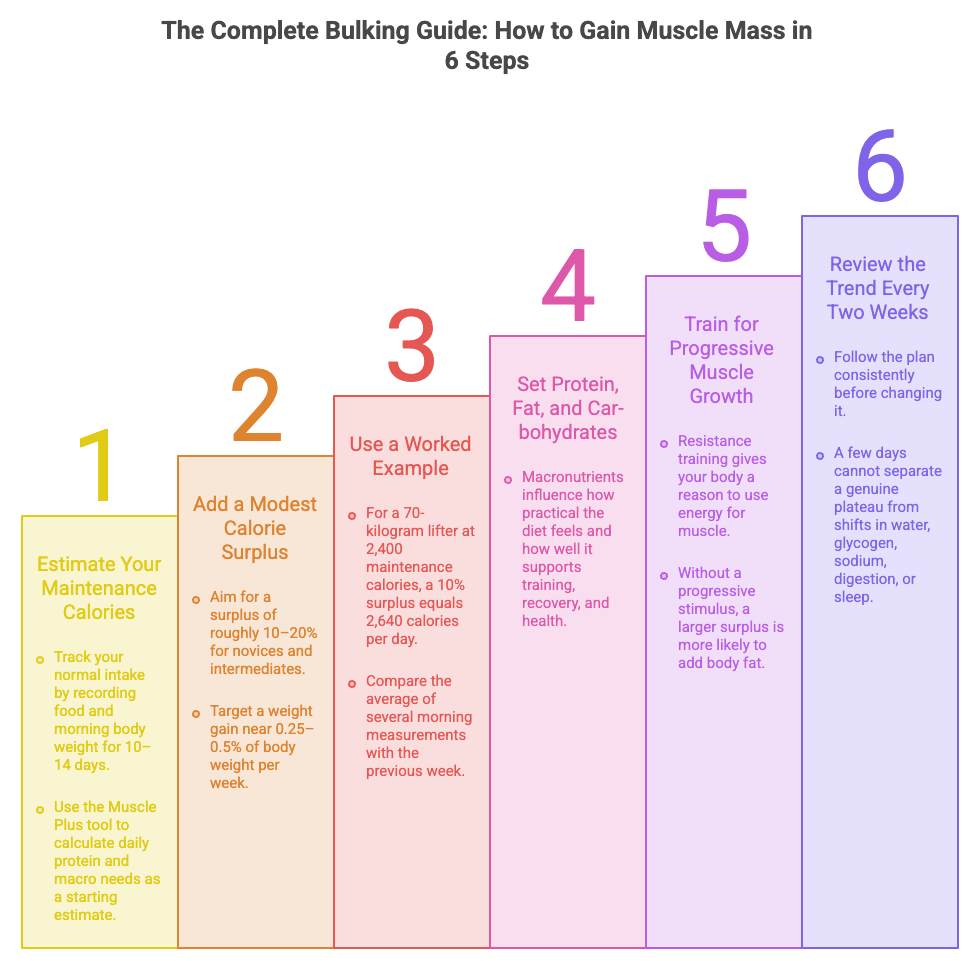
The Complete Bulking Guide: How to Gain Muscle Mass in 6 Steps
The most reliable approach is a feedback loop. You choose a sensible starting target, follow it consistently, compare your results with an expected range, and make one small adjustment at a time.
Step 1: Estimate Your Maintenance Calories
Maintenance calories are the approximate amount that keeps your average body weight stable. An online estimate is useful, but real-world tracking is more personal.
Method A: Track Your Normal Intake
Record your food and morning body weight for 10–14 days. Weigh yourself after using the bathroom and before eating or drinking, under similar conditions each time. Compare weekly averages rather than individual readings.
If your weekly-average weight is stable, your average calorie intake is close to maintenance. If your weight is rising or falling, the number still gives you a starting point that you can refine.
Method B: Use a Calculator as a Starting Estimate
A calculator can estimate energy and macronutrient needs from your body size, activity, and goal. Use the Muscle Plus tool to calculate your daily protein and macro needs, then confirm the estimate against two weeks of real data.
No calculator can perfectly predict your daily movement, training output, digestion, or metabolism. Treat the result as a starting hypothesis, not a permanent prescription.
Step 2: Add a Modest Calorie Surplus
A review of off-season bodybuilding nutrition recommends a surplus of roughly 10–20% for novice and intermediate bodybuilders, with advanced athletes using a more conservative approach. It also proposes a target gain near 0.25–0.5% of body weight per week for novices and intermediates (Iraki et al., 2019).
Many recreational lifters should begin near the lower end. A 5–10% surplus may be enough for trained people or anyone especially concerned about fat gain. A 10–15% starting surplus can suit a lean beginner who has difficulty gaining weight. Going straight to 20% is rarely necessary.
| Training status and situation | Sensible starting surplus | Initial weekly trend to monitor |
| Advanced or fat-gain-prone lifter | About 5% | Lower end of the 0.25% range or slower |
| Intermediate lifter | About 5–10% | Roughly 0.25% of body weight |
| Lean novice with consistent training | About 10–15% | Roughly 0.25–0.5% of body weight |
| Hardgainer not gaining after verified tracking | Add calories gradually | Move into the appropriate range over two-week blocks |
These are starting ranges, not guarantees. Training age, genetics, sex, body composition, daily activity, and measurement error all affect the result.
Step 3: Use a Worked Example
Consider a 70-kilogram lifter whose tracked maintenance intake is 2,400 calories. A 10% surplus adds 240 calories, producing a starting target of 2,640 calories per day.
At 0.25–0.5% of body weight per week, the initial target trend is about 0.175–0.35 kilograms per week. The lifter should not react if Monday’s scale weight jumps after a salty meal. They should compare the average of several morning measurements with the previous week.
Step 4: Set Protein, Fat, and Carbohydrates
Calories influence whether your weight rises. Macronutrients influence how practical the diet feels and how well it supports training, recovery, and health.
Step 5: Train for Progressive Muscle Growth
Food supplies energy and building materials. Resistance training gives your body a reason to use them for muscle. Without a progressive stimulus, a larger surplus is more likely to add body fat.
Step 6: Review the Trend Every Two Weeks
Follow the plan consistently before changing it. A few days cannot separate a genuine plateau from shifts in water, glycogen, sodium, digestion, or sleep.
Bulking Macros: How Much Protein, Carbs, and Fat?
A good macro plan is specific enough to guide you but flexible enough to survive work, university, family meals, and social events.
Protein for Muscle Gain
For healthy adults who resistance train, 1.6–2.2 grams of protein per kilogram of body weight per day is a practical target. A meta-analysis of 74 randomized trials found small additional lean-mass benefits from increased protein during resistance training, with benefits in younger adults apparent at intakes of at least 1.6 g/kg/day (Nunes et al., 2022).
The 70-kilogram lifter in our example would target approximately 112–154 grams per day. A middle target such as 130–145 grams is easier to use than treating the highest number as mandatory.
Spread your protein across three to six meals. The off-season review proposes around 0.40–0.55 g/kg per meal, which equals about 28–38.5 grams for a 70-kilogram lifter (Iraki et al., 2019).
Whole foods can cover your full target. Protein powder is optional convenience. For a more detailed calculation, read how much protein you need per day.
Carbohydrates for Training Performance
Carbohydrates help support hard training and replenish muscle glycogen. After setting protein and fat, most remaining calories can come from carbohydrates.
The off-season review suggests that many bodybuilders may benefit from at least 3–5 g/kg/day, depending on training demands (Iraki et al., 2019). You do not need to force the upper end if you train less frequently or prefer more dietary fat.
Useful carbohydrate sources in Lebanon include rice, potatoes, oats, bread, fruit, lentils, beans, chickpeas, pasta, bulgur, and dairy. Place a useful portion before and after training if it improves performance and recovery.
Dietary Fat for Health and Practicality
Fat makes meals more energy-dense and helps with the absorption of fat-soluble vitamins. The off-season review recommends moderate intake, commonly around 20–35% of calories or approximately 0.5–1.5 g/kg/day depending on the person (Iraki et al., 2019).
Olive oil, tahini, nuts, seeds, avocado, eggs, dairy, and oily fish can help. Very high fat intake can crowd out carbohydrates, while extremely low fat intake makes the diet harder to sustain.
Complete Macro Example for a 70-Kilogram Lifter
At 2,640 calories, one workable setup is 140 grams of protein, 80 grams of fat, and about 340 grams of carbohydrates. This is only one distribution.
| Macronutrient | Daily target | Calories | Why it is set this way |
| Protein | 140 g | 560 | Falls within the evidence-based range and is easy to divide across four meals |
| Fat | 80 g | 720 | Supports food variety and energy density |
| Carbohydrates | 340 g | 1,360 | Fills the remaining calories and supports training |
| Total | — | 2,640 | Starting target to validate against the two-week trend |
If you prefer more fat and fewer carbohydrates, the plan can still work. Total calories, adequate protein, diet quality, and training performance matter more than one “perfect” ratio.
Bulking Diet: Build Meals You Can Repeat
A successful bulking diet should be enjoyable, affordable, and digestible. If the plan only works when every meal is weighed and prepared at home, it may fail as soon as your schedule changes.
Use a Four-Part Meal Formula
Build most main meals from four components: a protein source, a carbohydrate source, fruit or vegetables, and an energy-adjustment ingredient.
| Component | Lebanese-friendly options | Function |
| Protein | Eggs, chicken, lean beef, tuna, fish, laban, Greek-style yogurt, labneh, milk, lentils, chickpeas | Supports daily protein and meal quality |
| Carbohydrate | Rice, potatoes, oats, pasta, bulgur, pita, fruit, beans | Fuels training and adds calories |
| Produce | Tomatoes, cucumbers, greens, peppers, citrus, bananas, berries, seasonal fruit | Adds fiber, vitamins, minerals, and variety |
| Energy adjustment | Olive oil, tahini, nuts, nut butter, dried fruit, extra rice or bread | Raises calories without making every meal much larger |
You do not need bodybuilding-only foods. Familiar meals can fit when portions and totals support the goal.
Sample One-Day Lean-Bulk Meal Plan
The following example shows structure, not a prescription. Portion sizes should change with your calorie and protein targets.
| Meal | Example | Practical purpose |
| Breakfast | Oats cooked with milk, banana, yogurt, and a spoon of peanut butter; eggs on the side | Protein, carbohydrates, and easy calorie density |
| Lunch | Grilled chicken, rice, fattoush or mixed salad, yogurt, and olive oil | Balanced high-protein main meal |
| Pre-workout snack | Pita with labneh and turkey or tuna, plus fruit | Carbohydrate and protein without excessive volume |
| Post-workout or dinner | Lean beef or fish, potatoes or pasta, cooked vegetables, and bread as needed | Refuels training and closes the protein target |
| Optional evening snack | Laban, Greek-style yogurt, labneh, milk, nuts, or a convenient protein shake | Helps reach calories and protein without another large meal |
For more detail on timing and food selection, see what to eat before and after the gym.
How to Eat More When You Have a Small Appetite
Do not begin by doubling every plate. Add low-volume calories in small steps.
Use olive oil, tahini, nuts, nut butter, dried fruit, dairy, smoothies, and slightly larger starch portions. Drink most of your water between meals if large drinks make you full. Choose some cooked vegetables instead of enormous raw salads when food volume becomes uncomfortable.
A smoothie made from milk, oats, banana, yogurt, and nut butter can add energy without requiring another full meal. A mass gainer can provide similar convenience, but it is not automatically better than a homemade shake.
Keep Digestion and Diet Quality in the Plan
A bulk should not leave you constantly bloated, sluggish, or uncomfortable. Increase fiber and total food gradually, chew slowly, and identify ingredients that repeatedly cause symptoms.
Most meals should be based on minimally processed foods, but flexibility helps adherence. A dessert or restaurant meal can fit when it does not displace protein, produce, or your normal routine.
Bulking Workout Plan for Muscle Hypertrophy
The 2026 American College of Sports Medicine position stand synthesized 137 systematic reviews involving more than 30,000 participants. Progressive resistance training improved muscle size, while higher weekly volume—around 10 or more sets per muscle group—enhanced hypertrophy (Currier et al., 2026).
That does not mean every beginner should immediately perform 20 hard sets per muscle. Start with recoverable volume, use good technique, and add work only when performance and recovery support it.
A Simple Three-Day Full-Body Program
Train on nonconsecutive days, such as Monday, Wednesday, and Friday. The sets below are working sets after warm-ups.
| Day | Exercise | Sets × reps | Main focus |
| A | Squat or leg press | 3 × 6–10 | Quadriceps and glutes |
| A | Bench press or machine chest press | 3 × 6–10 | Chest, shoulders, and triceps |
| A | Seated row | 3 × 8–12 | Back and biceps |
| A | Romanian deadlift | 2 × 8–12 | Hamstrings and glutes |
| A | Lateral raise | 2 × 12–20 | Side delts |
| B | Deadlift variation or hip thrust | 3 × 5–8 | Posterior chain |
| B | Overhead press | 3 × 6–10 | Shoulders and triceps |
| B | Lat pulldown or assisted pull-up | 3 × 8–12 | Lats and biceps |
| B | Split squat | 2 × 8–12 per leg | Legs and stability |
| B | Curl plus triceps extension | 2 × 10–15 each | Direct arm work |
| C | Front squat or hack squat | 3 × 8–12 | Quadriceps and glutes |
| C | Incline dumbbell press | 3 × 8–12 | Upper chest and shoulders |
| C | Chest-supported row | 3 × 8–12 | Upper back |
| C | Leg curl | 3 × 10–15 | Hamstrings |
| C | Calf raise and abdominal exercise | 3 × 10–20 each | Calves and trunk |
Choose variations you can perform safely through a comfortable range of motion. If pain persists or changes your movement, stop and seek qualified assessment.
How Progressive Overload Works
Use a rep range instead of forcing weight increases every session. Suppose your bench target is 3 × 6–10. Keep the same weight until you can complete three controlled sets near the top of the range.
Then add the smallest practical load and allow the reps to drop. You can also progress through better technique, a fuller pain-free range of motion, an extra repetition, or an additional set when volume is genuinely needed.
Training to complete failure is not mandatory for growth. Most working sets can finish with roughly one to three good repetitions left. This maintains effort without turning every exercise into a form breakdown contest.
Should You Do Cardio While Bulking?
Yes. Moderate cardio can support health, conditioning, appetite regulation, and work capacity. Two or three easy sessions of 20–30 minutes can fit around resistance training for many people.
Avoid increasing cardio and lifting volume aggressively at the same time. If leg performance or recovery declines, separate hard cardio from lower-body sessions and review total workload.
How to Track a Bulk and Adjust Calories
The scale alone cannot tell you how much muscle you gained. Use several indicators so one noisy measurement does not control your plan.
Your Weekly Bulking Dashboard
| Metric | How to track it | What you want to see |
| Body weight | Several morning weigh-ins; compare weekly averages | Slow, consistent gain appropriate to training status |
| Waist | Same site, conditions, and tape tension every one or two weeks | Stable or slowly changing, not racing ahead of performance |
| Gym performance | Record load, reps, sets, and technique | Gradual progress across several key lifts |
| Photos | Same lighting, distance, and pose every four weeks | Long-term muscular change rather than daily judgment |
| Recovery | Note sleep, soreness, motivation, and joint comfort | Enough recovery to repeat productive training |
| Digestion and appetite | Note persistent bloating, reflux, or discomfort | A diet you can follow without constant symptoms |
The Two-Week Calorie Adjustment Rule
Do not change calories after three days. Follow the target for two consistent weeks, then use the trend.
| Two-week result | Likely interpretation | Next action |
| Weight is stable and performance is not improving | Surplus may be too small or adherence may be inconsistent | Verify tracking, then add about 100–150 calories per day |
| Weight is below target but performance is improving | Progress may still be productive | Hold or add a small amount based on experience and preference |
| Weight is within target and waist is controlled | Plan is working | Keep calories unchanged |
| Weight is above target and waist rises quickly | Surplus is probably larger than needed | Remove about 100–200 calories per day and reassess |
| Weight rises but training does not progress | Food is not the main limitation | Review program quality, effort, technique, sleep, and stress |
| Weight suddenly jumps for several days | Often water, glycogen, sodium, or digestion | Wait for the weekly average before acting |
Make one change at a time. If you change calories, training volume, cardio, and supplements together, you will not know which factor affected the result.
Best Supplements for Bulking: What Helps and What Is Optional
Supplements can improve convenience or support training, but they cannot rescue inconsistent eating, poor programming, or inadequate sleep. The U.S. Food and Drug Administration notes that supplements can interact with medicines and may cause adverse effects. It recommends discussing use with a healthcare professional, especially when health conditions, medications, laboratory tests, or surgery are involved (FDA).
Protein Powder
Protein powder helps when food alone does not conveniently meet your target. It is not more “muscle building” than an adequate whole-food diet; it is simply portable, measurable, and easy to consume.
Whey suits many lifters because it provides complete protein in a compact serving. Casein, blended proteins, or plant-based options can also work. The most important question is whether the product helps you meet your total intake and suits your digestion.
Read the detailed guide to the best protein powder for muscle gain in Lebanon or compare whey concentrate vs isolate. One practical option available locally is Scitec 100% Whey Protein Professional.
Creatine Monohydrate
Creatine monohydrate is among the most studied sports supplements. The International Society of Sports Nutrition describes 3–5 grams per day as a standard maintenance approach after optional loading (Kreider et al., 2017).
A 2023 meta-analysis found that adding creatine to resistance training produced a small additional effect on directly measured regional hypertrophy (Burke et al., 2023). This is useful, but it is not a shortcut to dramatic growth.
A loading phase is optional. Daily consistency matters more than an exact clock time. Early weight gain can include water stored with creatine, so do not mistake every scale change for new muscle or fat.
See how to take creatine for best results or view Scitec Creatine Monohydrate.
Mass Gainers
A mass gainer combines calories, carbohydrates, and protein in a convenient drink. It may help someone who repeatedly falls short because of low appetite or a demanding schedule.
It is not necessary if normal food already covers your calories. Before buying one, compare the serving size, protein, carbohydrates, sugars, digestion, and cost per serving. You can also make a shake with milk, oats, banana, yogurt, and nut butter.
Browse weight gainers for hardgainers only after you know the calorie gap the product needs to fill.
Pre-Workout and Vitamins
A pre-workout may improve energy or focus, often because it contains caffeine. It does not replace sleep, carbohydrates, hydration, or a sensible program. Be cautious with total caffeine, late-day use, medication interactions, and formulas that hide ingredient amounts.
Vitamins are most useful when they correct a dietary shortfall or a diagnosed deficiency. More is not always better. If you want to review available options, start with pre-workout support and ask a qualified professional when health factors are involved.
Authenticity Matters in Lebanon
Counterfeit or poorly stored products can undermine trust and safety. Buy from a verifiable authorized source, inspect seals and labels, keep the receipt, and question unrealistic claims.
Muscle Plus is the official and exclusive Scitec Nutrition agent in Lebanon. Read how to spot fake supplements in Lebanon and review common supplement mistakes beginners make.
Recovery: Build Muscle Outside the Gym
Training starts the adaptation. Recovery gives you the chance to repeat quality training and support that adaptation.
Prioritize Consistent Sleep
Sleep affects alertness, appetite, training quality, and recovery. In a small controlled study, one night of total sleep deprivation reduced measured muscle protein synthesis in healthy young adults. The result shows a plausible recovery cost, although one acute study does not mean a single bad night ruins your progress (Lamon et al., 2021).
Keep a regular sleep schedule, allow enough time in bed, limit late caffeine, and make the room dark and comfortable. If poor sleep persists despite good habits, discuss it with a healthcare professional.
Manage Hydration, Stress, and Rest Days
Drink regularly and increase fluid when heat, sweating, or training demands rise. This is especially relevant during warm Lebanese weather. Use thirst, urine color, and performance as practical signals while recognizing that medical conditions can change fluid needs.
Rest days are not failed training days. They are part of the program. Light walking, mobility work, meal preparation, and consistent sleep can make the next session more productive.
10 Common Bulking Mistakes
1. Starting With Too Many Calories
A huge surplus produces fast scale change, not guaranteed fast muscle growth. Begin conservatively and earn increases through the trend.
2. Changing the Plan Every Few Days
Water and digestion can hide the real direction. Compare weekly averages and review two consistent weeks.
3. Eating Protein but Ignoring Total Calories
High protein cannot create weight gain when your total intake remains below what you expend.
4. Buying Supplements Before Fixing Meals
Supplements should solve a defined problem, such as convenience or a repeated intake gap. They should not replace your basic diet.
5. Training Without a Logbook
If you do not record sets, reps, loads, and technique notes, it is difficult to prove that training is progressing.
6. Adding Volume Without Recovering
More exercises are useful only when you can perform and recover from them. Excess volume can reduce effort and joint comfort.
7. Treating Every Set as a Maximum Test
Frequent grinders and failed repetitions can add fatigue faster than useful training. Keep most work controlled.
8. Avoiding All Cardio
Conditioning supports health and can improve your ability to handle training. Keep the dose compatible with recovery.
9. Ignoring Waist and Photos
Scale weight is incomplete. Combine it with waist, performance, photos, and how your clothes fit.
10. Staying in a Surplus Without a Review Date
A bulk should have checkpoints. Decide when you will reassess body composition, health, motivation, and goal relevance.
When Should You End a Bulk?
End or pause the surplus when the original goal is achieved, fat gain is outpacing muscle-related progress, training quality is falling, or the plan no longer fits your health and lifestyle.
You do not need to jump directly into an aggressive cut. Move calories toward your new maintenance level, keep protein and training consistent, and watch the two-week trend. Maintenance can consolidate habits and give you a psychological break from constant gaining or dieting.
A short fat-loss phase may be useful if body fat has risen beyond your preference. The right timing depends on your starting point, progress, and priorities rather than a fixed calendar date.
Frequently Asked Questions
How Many Calories Should I Eat to Bulk?
Start from estimated maintenance and add roughly 5–15% based on your training experience, leanness, appetite, and tolerance for fat gain. Many people do well near the lower end. Validate the number against two weeks of weekly-average weight and gym performance.
How Much Protein Do I Need to Gain Muscle Mass?
A practical target for healthy resistance-trained adults is about 1.6–2.2 g/kg/day. Divide it across three to six meals. If food already covers the target, extra powder is not required.
How Fast Should I Gain Weight During a Bulk?
Novice and intermediate bodybuilders often use approximately 0.25–0.5% of body weight per week as an initial range. Advanced lifters usually need a slower, more conservative approach because their potential rate of new muscle gain is lower.
Can I Gain Muscle Without Gaining Fat?
Some beginners, returning lifters, and people with higher body fat can gain muscle near maintenance while losing fat. During a deliberate surplus, some fat gain is possible. A smaller surplus, progressive training, and regular tracking help limit it.
What Are the Best Foods for Bulking?
Use foods that make calories, protein, and diet quality easy to sustain. In Lebanon, practical options include eggs, dairy, chicken, fish, lean beef, lentils, chickpeas, rice, potatoes, oats, pita, fruit, olive oil, tahini, and nuts.
Do I Need Supplements to Bulk?
No. Food, training, and recovery are the foundation. Protein powder can improve convenience, creatine can support high-intensity training and may add a small hypertrophy benefit, and mass gainers can help people with low appetite.
Is Creatine Good for Muscle Gain?
Creatine monohydrate is well studied and can improve high-intensity training capacity. When combined with resistance training, research suggests a small additional hypertrophy effect. It works alongside training; it does not replace it.
Is a Mass Gainer Better Than Whey Protein?
They solve different problems. Whey mainly helps close a protein gap. A mass gainer adds substantially more calories and carbohydrates. Choose based on the gap in your diet, not the size of the tub.
How Long Should a Bulk Last?
A productive bulk often lasts several months because muscle grows slowly. Use four-week checkpoints and a larger review every eight to twelve weeks. Continue only while performance, waist, health, and motivation remain aligned with your goal.
Should Beginners Bulk?
A lean beginner who wants size and can train consistently may benefit from a modest surplus. A beginner with a primary fat-loss goal may be better near maintenance or in a controlled deficit while learning to lift.
How Can I Bulk With a Small Appetite?
Add calories gradually through olive oil, tahini, nuts, nut butter, dairy, dried fruit, smoothies, and larger starch portions. Avoid forcing enormous meals. A homemade shake or commercial gainer can help when a defined gap remains.
Can Women Follow This Bulking Guide?
Yes. The same principles apply: progressive resistance training, adequate protein, a controlled energy target, and trend-based adjustments. Individual calorie needs and preferred rate of gain vary, so the plan should be personalized rather than based on sex stereotypes.
Start Your Muscle-Gain Plan Today
A successful bulk is controlled, measurable, and patient. Establish maintenance, add a modest surplus, eat enough protein, train progressively, recover well, and adjust only after the trend gives you a reason.
Use the Muscle Plus Protein Calculator to create your starting target. Then explore authentic sports supplements in Lebanon only for the gaps your diet and routine cannot conveniently fill.
Need help choosing between protein, creatine, or a weight gainer? Contact the Muscle Plus team. Share this guide with your training partner, and comment with the bulking challenge you want us to answer next.
Written by: Muscle Plus Editorial Team
Supplement experts at Muscle Plus, Lebanon’s official and exclusive Scitec Nutrition agent.