
If you are asking how many calories you need to build muscle, the most useful answer is not a fixed number. Start with your maintenance calories, then add a small, controlled surplus. For many lifters, that means about 5–10% above maintenance, often roughly 150–300 extra calories per day. Larger people or people with very high activity may need more.
That number is only a starting point. Your age, body size, biological sex, daily movement, training experience, appetite, and current body-fat level all affect your energy needs. The most reliable plan combines a calorie estimate with your weekly body-weight trend, gym performance, waist measurement, and recovery.
The short answer: how many calories should you eat to build muscle?
Most people should begin with this simple formula:
Muscle-building calories = estimated maintenance calories + 5–10%
If your maintenance intake is 2,400 calories, a sensible starting target is approximately 2,520–2,640 calories per day. If your maintenance is 3,000 calories, start at about 3,150–3,300 calories.
A 250–500-calorie surplus is often mentioned in popular fitness advice. It can be appropriate for some larger or highly active people, but it is not a universal rule. A large surplus can make your scale weight rise faster without producing a similar increase in muscle.
The exact calorie surplus that maximizes muscle gain is still uncertain. A 2019 review of energy surplus and muscle hypertrophy concluded that the ideal surplus had not been validated and that individual factors such as training experience and energy status matter. A small 2023 study comparing maintenance, 5%, and 15% surplus conditions found that faster weight gain mainly increased fat gain rather than clearly improving muscle thickness or strength.
Do you need a calorie surplus to build muscle?
A surplus can make muscle growth easier, but it is not a magic requirement for every person. You need a strong training stimulus, adequate protein, enough recovery, and sufficient energy. A surplus may support training quality and recovery, but eating more cannot replace progressive resistance training.
Beginners, people returning after a long training break, and some people with higher body-fat levels may gain muscle while eating around maintenance or even in a modest calorie deficit. This is often called body recomposition. The energy-surplus review by Slater and colleagues discusses this possibility, especially in people who are new to resistance training or carry more stored body fat.
Experienced, lean lifters usually have less room for rapid muscle growth. They may benefit from a small surplus, but they also have more to lose from unnecessary fat gain. For them, maintenance calories or a modest 5% surplus may be more appropriate than an aggressive bulk.
Choose a surplus, maintenance, or deficit
| Your situation | Practical starting point | Main objective |
| New to lifting and relatively lean | Maintenance plus 5–10% | Support training and steady growth |
| Intermediate lifter with stable weight | Maintenance plus 5–8% | Gain slowly while limiting fat gain |
| Advanced lifter | Maintenance to plus 5% | Prioritize quality over scale speed |
| Higher body-fat level and new to lifting | Maintenance or a modest deficit | Recomposition may be realistic |
| Losing weight unintentionally | Add calories gradually | Restore energy balance before judging progress |
These are starting points, not diagnoses. If you have a medical condition, are under 18, are pregnant, or have a history of disordered eating, seek individualized advice from a qualified healthcare professional before changing your calorie intake.
How to calculate your maintenance calories
Your maintenance calories are the approximate amount of energy you need to keep your body weight stable over time. The technical term is total daily energy expenditure, or TDEE. TDEE includes your resting energy needs, movement, exercise, and the energy used to digest food.
An equation can give you a useful starting estimate. Your food and body-weight records then make the estimate more personal. No calculator knows your exact spontaneous movement, training intensity, appetite, digestion, or daily routine.
Step 1: Estimate your basal metabolic rate
The Mifflin–St Jeor equation is commonly used to estimate resting energy needs. It uses body weight, height, age, and a sex-specific coefficient.
For men:
BMR = 9.99 × weight in kilograms + 6.25 × height in centimetres − 4.92 × age + 5
For women:
BMR = 9.99 × weight in kilograms + 6.25 × height in centimetres − 4.92 × age − 161
The original Mifflin–St Jeor research provides the equation. It estimates resting needs, not your complete daily calorie target.
Step 2: Multiply by your activity level
Multiply your estimated BMR by an activity factor to estimate TDEE. Choose the factor that best matches your whole lifestyle, not only your gym sessions.
| Activity pattern | Approximate factor |
| Sedentary, little structured exercise | 1.20 |
| Light activity or training one to three days weekly | 1.375 |
| Moderate activity or training three to five days weekly | 1.55 |
| High activity or hard training most days | 1.725 |
| Very high activity, physical work plus frequent training | 1.90 |
These factors are approximations. Someone who trains four times weekly but sits most of the day may need a lower factor than someone who walks extensively and has a physically demanding job.
For another evidence-based estimate, you can use the NIDDK Body Weight Planner. It is designed to model calorie intake, activity, and body-weight change. It is not a muscle-gain calculator, so you still need to apply the surplus and monitoring steps below.
Step 3: Add your muscle-building surplus
Once you have an estimated TDEE, multiply it by 1.05 or 1.10. For example, a person with an estimated maintenance intake of 2,600 calories would begin at approximately 2,730–2,860 calories per day.
Start at the lower end if you are an experienced lifter, have a higher body-fat level, or want to minimize fat gain. Start closer to the upper end if you are new to lifting, very lean, highly active, or consistently losing weight despite a structured diet.
Worked example: calculating calories for muscle gain
Consider a 28-year-old man who weighs 75 kilograms and is 178 centimetres tall. He trains with weights four days per week and has a moderately active daily routine.
First, estimate BMR:
9.99 × 75 + 6.25 × 178 − 4.92 × 28 + 5 = approximately 1,729 calories
Next, multiply by an activity factor of 1.55:
1,729 × 1.55 = approximately 2,680 calories for maintenance
Finally, add a 5–10% surplus:
2,680 × 1.05–1.10 = approximately 2,815–2,950 calories per day
A practical starting target could be 2,850 calories per day. The person should then track morning weigh-ins, calculate a weekly average, and hold the target long enough to see a trend.
This example is not a prescription. If the person’s weight is already rising at maintenance, the calculated TDEE may be too low. If weight is falling, the real maintenance intake may be higher. Use the formula as a starting hypothesis, then test it against real data.
How much surplus is best for a lean bulk?
A lean bulk aims to increase muscle while keeping unnecessary fat gain as low as possible. The most practical strategy is to use the smallest surplus that produces a consistent, acceptable rate of weight gain.
A beginner may gain weight faster because the training stimulus is new. An advanced lifter generally needs a slower rate because the potential for new muscle growth is smaller. Your target should therefore be based on training age, body size, and how much fat gain you are willing to accept.
| Training status | Suggested weekly scale-weight trend | Adjustment approach |
| Beginner | About 0.25–0.5% of body weight | Use the lower end if fat gain is a concern |
| Intermediate | About 0.1–0.25% | Increase slowly only when the trend is flat |
| Advanced | About 0.1–0.2% or maintenance | Prioritize performance and measurements |
These ranges describe total body-weight change, not pure muscle gain. Early increases can include glycogen, water, food volume, and fat. A fast increase on the scale does not prove that you are building muscle faster.
The 2023 resistance-training study by Helms and colleagues is useful here. Participants assigned to larger intended surpluses gained body mass more quickly, but the researchers found stronger evidence that faster gain increased skinfold thickness than evidence that it improved muscle thickness. The sample was small and the intervention lasted only eight weeks, so it should inform—not dictate—your plan.
How to know if your calorie target is working
Do not change your calories because of one morning weigh-in. Body weight moves with hydration, sodium, glycogen, bowel contents, sleep, and hormonal changes. A useful system is to weigh yourself under similar conditions after waking and using the bathroom, then compare weekly averages.
Hold your initial calorie target for two to three weeks when possible. During that period, track your training performance, waist measurement, progress photos, appetite, digestion, and recovery. The goal is not simply to make the scale rise. The goal is to improve performance and body composition without an unwanted acceleration in fat gain.
When to add calories
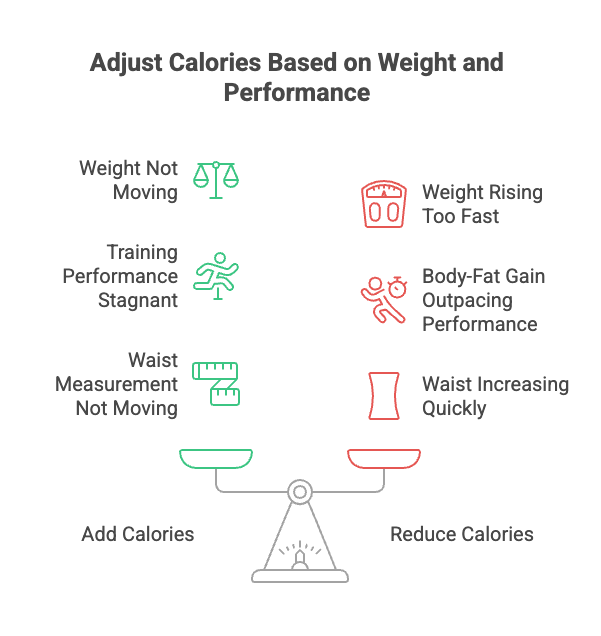
Add approximately 100–150 calories per day if your two-week average is not moving, your training performance is stagnant, and you are confident that you are logging food accurately. Keep the change small so you can identify what works.
If you are not gaining weight but your lifts, measurements, and recovery are improving, you may not need to change anything immediately. Muscle gain can occur slowly, especially in experienced lifters.
When to reduce calories
Reduce approximately 100–150 calories per day if your weight is rising faster than your target, your waist is increasing quickly, or your body-fat gain is clearly outpacing performance improvement. Do not respond to a single high weigh-in by cutting food aggressively.
If your weight is falling, first check portion accuracy, missed meals, step count, training volume, and appetite. A person who believes they are eating 2,800 calories may average far less if meals are frequently skipped.
How many calories and macros do you need?
Calories provide the total energy budget. Protein supplies amino acids, carbohydrates support training fuel, and dietary fat helps provide essential fatty acids and supports normal physiological function. You do not need a perfect macro ratio, but you do need adequate amounts of each macronutrient.
Protein for muscle gain
For most people who lift, a practical daily protein target is approximately 1.4–2.0 grams per kilogram of body weight. Many lifters can use about 1.6–2.2 g/kg/day as a simple working range, especially when dieting, highly lean, or trying to make protein intake more certain.
The ISSN position stand on protein and exercise supports 1.4–2.0 g/kg/day for most exercising people. A peer-reviewed review of protein and hypertrophy reported that additional benefit tends to level off around 1.6 g/kg/day, although individual responses vary.
For a 75-kilogram lifter, 1.6–2.0 g/kg equals approximately 120–150 grams of protein per day. Divide that across three to five meals. A serving of roughly 20–40 grams is practical for many adults, depending on body size and the protein source.
Use the Muscle Plus protein calculator as a planning aid, and read the local guide on how much protein per day. Whey protein is optional. It can make a target easier to reach, but it does not replace a balanced diet.
Carbohydrates for training performance
Carbohydrates are useful because hard resistance training relies heavily on stored muscle glycogen. Include foods such as rice, potatoes, oats, bread, pasta, fruit, beans, and other carbohydrate sources that fit your preferences and digestion.
If your training performance declines after starting a surplus, do not automatically add more protein. First check total calories, carbohydrate intake, hydration, sleep, and the quality of your training program. Extra protein is not always the best solution to a low-energy training problem.
Dietary fat for health and calories
Dietary fat is calorie-dense, which can help if you struggle to eat enough. Olive oil, tahini, nuts, seeds, avocado, eggs, dairy, and fatty fish can increase energy intake without requiring very large portions.
Avoid turning a muscle-building surplus into a diet dominated by ultra-processed foods. Nutrient-dense foods support fiber, vitamins, minerals, and digestion. Treat foods can fit, but they should not crowd out protein, produce, carbohydrates, and healthy fats.
What should you eat to reach your calorie target?
Start with three or four balanced meals. Each meal can include a protein source, a carbohydrate source, vegetables or fruit, and a source of dietary fat. Add a snack when needed rather than forcing enormous meals.
For Lebanese lifters, practical meals might include eggs with bread and labneh, chicken with rice, meat with potatoes, lentils with rice, yogurt with oats and fruit, or a sandwich with a protein-rich filling. Portion sizes should match your individual calorie and protein targets.
If appetite is low, liquid calories can help. A shake made with milk or yogurt, oats, fruit, nut butter, and whey can be easier to consume than another large plate of food. You can explore protein powders in Lebanon or meals and snacks for weight gain through the existing Muscle Plus categories.
A mass gainer can be convenient for someone who repeatedly fails to reach an energy target with ordinary food. It is not mandatory, and it still counts toward daily calories. Review the available mass gainers and weight-gain supplements and choose based on ingredients, serving size, tolerance, and total diet.
Does meal timing matter for muscle gain?
Total calories and total daily protein matter more than a narrow post-workout window. Try to eat protein at regular intervals and include a meal or snack around training if it improves energy and recovery.
A pre-workout meal can contain protein and easily digested carbohydrates. After training, another protein-containing meal is useful, especially if your next meal is several hours away. For practical meal ideas, see what to eat before and after the gym.
You do not need to eat every extra calorie immediately after lifting. The muscle-building response to resistance training lasts beyond the first few minutes. A consistent daily pattern is more important than chasing a supplement or meal-timing trick.
Do supplements increase your calorie needs?
Supplements do not automatically increase the calories you need. Your target depends on your body and activity, not on whether you take whey, creatine, or a pre-workout product.
Creatine monohydrate can support high-intensity training and may increase scale weight through additional water stored with muscle. That early water increase is not the same as fat gain. You can read how to take creatine for best results and review creatine monohydrate at Muscle Plus.
Whey or casein can help you reach protein goals. A product such as 100% Whey Protein Professional is a convenience option, not a substitute for calories from a varied diet. For trust and authenticity information in Lebanon, read about the official Scitec Nutrition agent in Lebanon.
Common calorie mistakes when trying to build muscle
Starting with an unnecessarily large surplus
A large surplus can feel motivating because the scale rises quickly. It can also increase fat gain, digestion problems, and the amount of dieting required later. Begin with a small surplus and adjust from evidence.
Treating a calculator as a measurement
A TDEE formula is an estimate. Your maintenance calories are better understood by observing stable body weight across several weeks while tracking intake consistently.
Confusing weight gain with muscle gain
Muscle growth is only one component of scale weight. Glycogen, water, food volume, fat, and muscle all affect the number on the scale. Combine weight trends with strength progress, waist measurements, and photos.
Using protein percentages instead of a protein target
A percentage-based macro plan can push protein far above what most lifters need. Set protein in grams per kilogram, set a reasonable minimum for fat, and allocate remaining calories to carbohydrates and preferred foods.
Ignoring training and recovery
Calories support muscle growth; they do not create the stimulus. Follow a progressive resistance-training plan, sleep consistently, manage fatigue, and use rest days appropriately. The Muscle Plus guide on supplements on rest days can help separate useful consistency from unnecessary supplementation.
How many calories should you eat to build muscle? A simple checklist
- Estimate maintenance with the Mifflin–St Jeor equation, an established calculator, or a stable-intake record.
- Start with approximately 5–10% above maintenance, usually 150–300 calories for many people.
- Set protein around 1.4–2.0 g/kg/day and include sufficient carbohydrates and fats.
- Weigh yourself under similar conditions and compare seven-day averages.
- Hold the plan for two to three weeks before making a small change.
- Add or remove 100–150 calories based on your trend, waist, performance, and recovery.
- Keep progressive resistance training at the center of the plan.
Frequently asked questions about calories for muscle gain
How many calories should I eat a day to build muscle?
Eat your maintenance calories plus a small surplus. A practical starting point is 5–10% above maintenance, which may equal about 150–300 extra calories for many people. Your body-weight trend and training results should determine whether you keep, increase, or reduce that target.
Is 1,500 calories enough to build muscle?
It depends on your body size, activity, sex, age, and current maintenance needs. For a smaller or less active person, 1,500 calories may be near maintenance. For a larger or highly active lifter, it may be a significant deficit. Calories are adequate for muscle gain only when they meet your personal energy needs and support training, recovery, and sufficient protein.
Is 1,200 calories enough to build muscle?
For many adults who train regularly, 1,200 calories is unlikely to provide enough energy, protein, carbohydrates, or micronutrients for a productive muscle-building phase. Do not use 1,200 calories as a generic muscle-gain target. If you are eating very little, losing weight unintentionally, or feeling fatigued, speak with a qualified healthcare professional.
Can you build muscle without a calorie surplus?
Yes, some people can build muscle at maintenance or in a modest deficit. This is more likely for beginners, people returning to training, and people with more body fat. A small surplus is often more helpful for lean, experienced lifters who are already close to their maximum potential.
How much of a calorie surplus do I need to build muscle?
Begin with about 5–10% above maintenance. A larger 10–15% surplus may be considered by someone who is very lean, highly active, or not gaining weight after accurate tracking. Use caution because larger surpluses may increase fat gain faster than muscle gain.
How do I know if my calorie surplus is working?
Look for a slow upward trend in weekly average body weight, stable or improving gym performance, manageable waist changes, and good recovery. If weight is unchanged for two to three weeks, add 100–150 calories. If weight and waist are rising too quickly, reduce 100–150 calories.
Should I eat more calories on training days?
You do not have to cycle calories. A consistent daily target is easier for many people. If you prefer higher training-day calories, keep your weekly average appropriate and avoid assuming that one hard workout justifies unlimited extra food.
How much protein should I eat with a calorie surplus?
Most exercising people can start around 1.4–2.0 g/kg/day. Spread protein across several meals and use whey or another supplement only when it makes the target easier to meet. More protein cannot compensate for poor training, inadequate carbohydrates, or inadequate total calories.
Can I gain muscle and lose fat at the same time?
It is possible, particularly for beginners, people returning after a break, and some people with higher body-fat levels. Use resistance training, adequate protein, and an appropriate calorie target. Advanced, lean lifters usually need more patience and may prefer separate gaining and fat-loss phases.
What should I do if I am gaining fat too quickly while bulking?
First compare seven-day weight averages and waist measurements rather than reacting to one weigh-in. If the trend is consistently faster than planned, reduce daily intake by about 100–150 calories. Keep protein and training consistent, then reassess after two or three weeks.
Final takeaway
The best answer to how many calories you need to build muscle is an individualized starting range, not a universal number. Estimate maintenance, add a modest 5–10% surplus, eat enough protein, train progressively, and adjust from real trends.
For lifters in Lebanon, Muscle Plus offers verified protein powders, weight-gain supplements, and Scitec Nutrition products to make a well-planned diet more convenient. Use supplements to fill practical gaps, not to replace food, training, sleep, or a sensible calorie strategy.
If this guide helped you set a better muscle-building target, share it with a training partner and leave a comment with your maintenance calories, surplus, training experience, and progress trend.
Written by the Muscle Plus Supplement Experts Editorial Team
This article was written by the Muscle Plus Supplement Experts Editorial Team, the editorial team behind Muscle Plus Lebanon. The team creates practical sports-nutrition content for Lebanese athletes and fitness enthusiasts, using current research, transparent sourcing, and product knowledge from Muscle Plus’s role as an official Scitec Nutrition agent in Lebanon. This article is educational and does not replace individualized advice from a qualified healthcare professional or registered dietitian.
Editorial review note: Calorie equations and surplus recommendations are estimates. Review this article periodically as new sports-nutrition evidence becomes available.
References
- Slater et al., “Is an Energy Surplus Required to Maximize Skeletal Muscle Hypertrophy Associated With Resistance Training?”
- Helms et al., “Effect of Small and Large Energy Surpluses on Strength, Muscle, and Skinfold Thickness in Resistance-Trained Individuals”
- Stokes et al., “Recent Perspectives Regarding the Role of Dietary Protein for the Promotion of Muscle Hypertrophy with Resistance Exercise Training”
- Jäger et al., “International Society of Sports Nutrition Position Stand: protein and exercise”
- Mifflin et al., “A new predictive equation for resting energy expenditure in healthy individuals”
- National Institute of Diabetes and Digestive and Kidney Diseases, Body Weight Planner