Choosing whey protein Lebanon shoppers can trust starts with a process, not a slogan. Compare the whey format, the finished-product label, and today’s value before choosing a current option. Prices, stock, and product details can change. Check the live page and the pack before purchase.
Disclosure: Muscle Plus is the exclusive Scitec Nutrition agent in Lebanon. This guide links to Muscle Plus commercial pages. Its independent education on processing, labels, quality, and safety is cited to external authority sources.
This guide does not name one universal “best” whey. It helps you make a label-first choice, then browse current Scitec options responsibly.
Start with the decision, not the tub
Use three steps. First, understand the format. Next, read the current label for ingredients and servings. Finally, compare live value and product information on the same date.
Choose the question you need answered
- Format: Learn the processing difference between concentrate, isolate, and hydrolysate.
- Label fit: Check protein per serving, ingredients, allergens, sweeteners, and serving size.
- Value: Compare current listed price against stated servings per pack.
- Verification: Inspect the pack and seller details before committing.
Readers who want deeper format context can use this whey concentrate vs. isolate comparison. For the current broad range, you can also compare all protein powders.
Why this guide does not name one universal “best” whey
A useful choice depends on the actual label, your preferences, your established tolerance, and live value. A processing name cannot answer every one of those questions. Comparative research does not establish a clear universal body-composition advantage for a processing label. Evidence comparing concentrate and isolate in those studies was low certainty. Read the systematic review and meta-analysis.
That is why this guide compares criteria rather than ranking tubs. It also avoids promises about muscle gain, recovery, digestion, or performance.
Whey protein Lebanon formats: concentrate, isolate, and hydrolysate
Format describes processing. It does not replace a finished-product label. The three labels below can guide questions, but none makes a product automatically right for everyone.
| Format | What the term means | What to check on the current label | What not to assume |
| Concentrate | A whey processing category with variable composition | Protein, carbohydrate or sugar lines, serving size, ingredients | A fixed protein or lactose amount |
| Isolate | A more highly filtered whey ingredient category | Protein per serving, lactose-related details, full ingredients | That it suits every lactose-sensitive person |
| Hydrolysate | Whey protein broken into smaller peptides through enzymatic processing | Ingredients, flavour preference, serving size, live value | A guaranteed training or digestion outcome |
Whey concentrate: compare the finished-product label
The American Dairy Products Institute describes whey protein concentrate as whey with sufficient non-protein constituents removed. Its standard requires at least 25% protein. Its examples also show that concentrate ingredients can vary markedly. See the ADPI whey protein concentrate standard.
For a buyer, “concentrate” is a starting point. Read the current pack’s protein per serving, carbohydrate or sugar lines, ingredients, and stated serving size. Then compare those fields with other products using the same method.
What the format name cannot tell you
A concentrate label does not provide a complete finished-product nutrition profile. Flavouring, sweeteners, enzymes, and serving size can change the consumer label. The ingredient standard is not a promise about every retail tub. ADPI explains the range within whey protein concentrate ingredients.
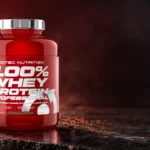
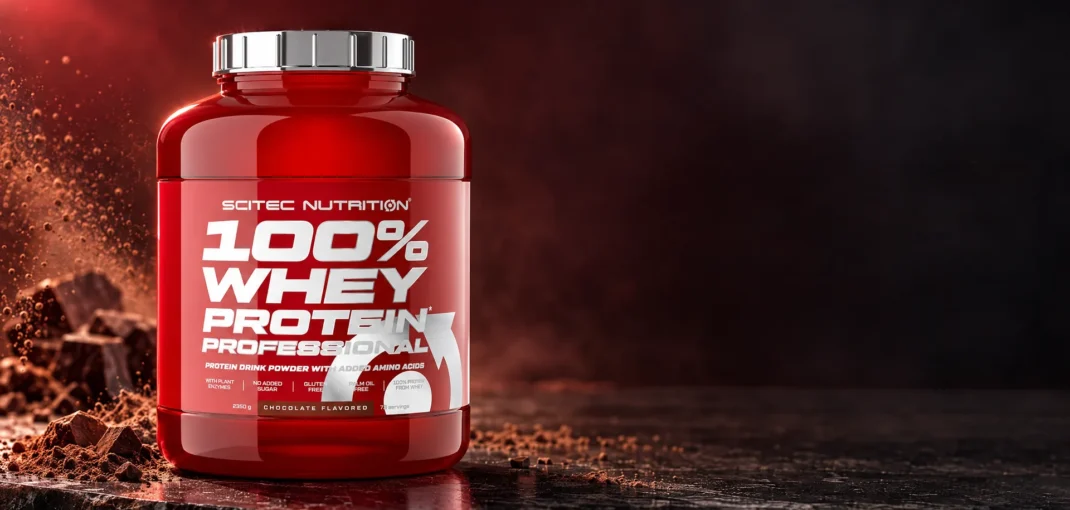
For a current standard-whey product page, see Scitec 100% Whey Protein Professional. Confirm its live label before deciding.
Whey isolate: a more highly filtered format
Under the ADPI ingredient standard, whey protein isolate has more non-protein constituents removed. That standard specifies at least 90% protein on a dry-matter basis. Its typical composition is lower in lactose than the concentrate examples. Read the ADPI whey protein isolate standard.
This is useful context, not a finished-pack guarantee. Review the product’s serving size, full ingredients, allergen statement, and your own established tolerance. A current product route is Scitec 100% Whey Isolate. Check the live page and pack rather than inferring its details.
Low lactose is not the same as allergy-safe
Whey is milk-derived. Lactose intolerance and milk allergy are different issues. Lactose tolerance varies between people, while a food allergy involves an immune reaction. NIDDK discusses individual lactose tolerance. FDA identifies milk as a major food allergen.
Anyone with a known milk allergy should avoid the allergen and follow their clinician’s advice. An isolate label is not a reason to treat whey as allergy-safe.
Hydrolysate: a processing difference, not a promised outcome
Hydrolysate means whey protein has been enzymatically broken into smaller peptides. The degree of hydrolysis can change product characteristics, including taste-related characteristics. Read the food-science review of whey protein hydrolysates.
Hydrolysate is not automatically a better route to a training result. The comparative evidence does not establish a universal outcome advantage by processing label. The available systematic review explains those limits.
A current format-specific path is Scitec 100% Hydro Isolate. Use its current label as the deciding document.
When an advanced format is worth comparing
Compare the current label, taste preference, ingredients, stated serving size, and cost per serving. Do not let a premium-sounding format replace those checks. Your own tolerance and clinician advice remain relevant.
Use this label-first checklist before you buy
A clear comparison starts with fields that can be checked today. Use the product page and the physical pack. Mark a field as “not stated” when it is unavailable.
The comparison table to complete from each current product page or pack
| Product / format | Protein per serving | Serving size | Calories | Carbohydrates / sugars | Full ingredients / sweeteners | Milk / allergen statement | Pack size / servings | Current price | Price per serving | Expiry / batch / tamper seal | Source / date checked |
| Option A | Read current label | Read current label | Read current label | Read current label | Read current label | Read current label | Check live page | Check live page | Calculate below | Inspect pack | Record source and date |
| Option B | Read current label | Read current label | Read current label | Read current label | Read current label | Read current label | Check live page | Check live page | Calculate below | Inspect pack | Record source and date |
| Option C | Read current label | Read current label | Read current label | Read current label | Read current label | Read current label | Check live page | Check live page | Calculate below | Inspect pack | Record source and date |
The U.S. FDA describes label elements such as serving details, ingredient information, and responsible-company information for dietary supplements. This is general consumer guidance, not Lebanese registration evidence. Read the FDA’s dietary-supplement questions and answers.
How to calculate price per serving without misleading comparisons
Current listed price ÷ stated servings per pack = cost per serving.
Record the source date beside every calculation. Compare only products with visible serving counts and current prices. Do not substitute scoop size for the stated number of servings. A lower tub price alone does not settle value.
Practical fit: flavour, unflavoured, clear and standard whey
“Unflavoured,” “clear,” and standard whey describe preferences or product styles. Start with the full ingredient list, intended use, and current label. Do not assume a flavour label predicts sweetness, mixability, or suitability.
If you want to compare current styles beside non-whey alternatives, use the live category to compare all protein powders. Casein, vegan, and other protein powders are not synonyms for whey.
Allergens, sweeteners and personal tolerance
Read the complete ingredient list and allergen statement before buying. NIDDK notes that lactose tolerance differs between individuals. It also lists whey among ingredients that signal lactose. Review NIDDK’s lactose-intolerance consumer guidance.
Whey remains milk-derived. A known milk allergy needs a different response than lactose intolerance. FDA’s food-allergy guidance explains the distinction. If suitability is uncertain, seek individual professional advice before using the product.
Whey protein price in Lebanon: compare live value, not a stale number
Whey protein price Lebanon searches reflect a practical decision. However, price, stock, and promotions change. Use a dated calculation from current information instead of relying on an old number.
Compare like with like
Start with current listed price and stated servings per pack. Then compare protein per serving, serving size, format, full ingredients, and pack size. This prevents a smaller tub, different serving count, or altered recipe from distorting the comparison.
A lower headline price is not automatically better value. It may represent a different pack, serving count, format, or ingredient list. Do not make a value verdict unless the comparison is current and reproducible.
Check current options before deciding
When your table is ready, shop whey protein supplements in Lebanon. Treat every product page as a live snapshot. Confirm its label, price, and availability at the time you shop.
Authenticity and quality checks for whey buyers
Pack and seller checks can reduce risk. They do not guarantee authenticity, safety, effectiveness, or local compliance. Use them alongside current product information and appropriate professional advice.
Inspect the product and seller information
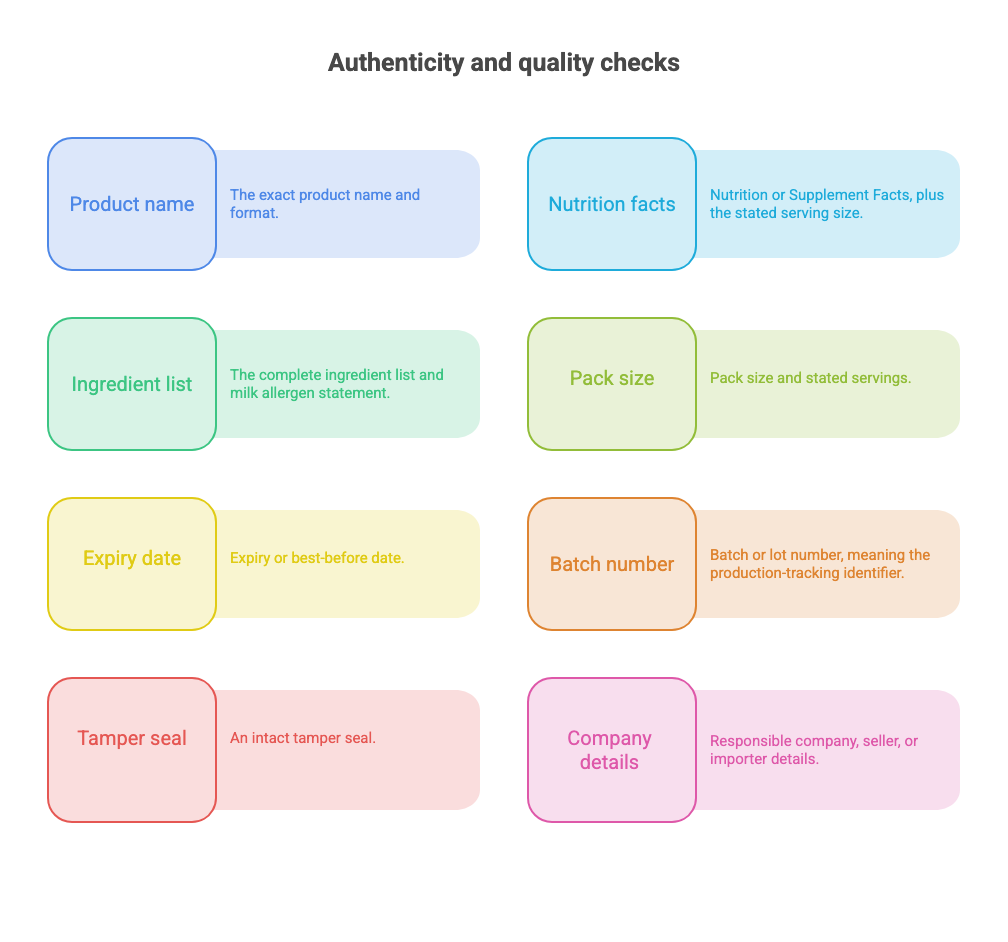
Before buying, check these visible items:
- The exact product name and format.
- Nutrition or Supplement Facts, plus the stated serving size.
- The complete ingredient list and milk allergen statement.
- Pack size and stated servings.
- Expiry or best-before date.
- Batch or lot number, meaning the production-tracking identifier.
- An intact tamper seal.
- Responsible company, seller, or importer details.
The FDA describes labels as a consumer information source. It notes that dietary supplements are not pre-approved for safety and effectiveness. That is a U.S. framework, not a statement about Lebanese approval. See the FDA guidance.
How to interpret third-party certification
An independently verifiable certification can add a quality or label-content check. It does not prove that a product is necessary, safe for everyone, or effective. NIH Office of Dietary Supplements gives this limitation. OPSS explains what third-party certification can assess.
Where a certification is shown, confirm the exact product or lot in the certifier’s database when available. Do not assume a seal applies to every flavour, size, or batch.
Use the official-agent and counterfeit guidance as a practical next step
For brand-specific purchasing context, read Muscle Plus’s page on the official Scitec Nutrition agent in Lebanon. For a practical pack-checking continuation, see how to spot fake supplements in Lebanon.
Those resources support your checks. They do not replace examination of the current pack, its lot details, and the seller information.
Where whey fits in a training and eating routine
Whey powder can be a convenient dietary-protein source. It does not replace varied meals. Count protein from food and drinks across the day before treating powder timing as the main decision.
Total daily protein comes before powder timing
For healthy adults, EFSA’s population reference intake is 0.83 g of protein per kilogram of body weight each day. It is a maintenance reference for total dietary protein, not a powder-serving recommendation. Read EFSA’s protein reference opinion.
For healthy, exercising adults, the ISSN position stand discusses total daily protein in an exercise context. It describes a range of 1.4–2.0 g/kg/day for most exercising individuals. It also emphasizes total intake rather than supplements alone. Read the ISSN position stand on protein and exercise.
These figures are context, not a personal prescription. You can calculate how much protein you need per day. You can also use the protein calculator. Treat either as educational support, not medical assessment.
Do not turn a population guideline into your personal prescription
A population reference does not prescribe a scoop amount. The suitable amount can vary with total diet, training, health status, and clinician guidance. Keep the product’s stated serving size visible when you compare options.
Timing and muscle-gain questions need context
This guide does not promise a timing result or a product result. Whole-day diet and individual context matter. For related site education, read when to take a protein shake and best protein powder for muscle gain in Lebanon.
Use those pages as additional reading, not as a guarantee of any outcome.
When to seek individual advice before using whey
Get individualized advice for kidney disease, pregnancy or nursing, childhood or adolescence, or medication use. Also seek it after a prior reaction or when following a clinician-directed diet. The NIH Office of Dietary Supplements flags added caution around medicines, pregnancy, nursing, and children. Read its consumer guidance.
Protein needs in chronic kidney disease can differ with the kidney problem and other individual factors. The National Kidney Foundation recommends input from the treating team or renal dietitian. See its CKD protein guidance.
Milk allergy is a separate issue. Whey is milk-derived, so follow your clinician’s allergy plan. FDA food-allergy guidance identifies milk as a major allergen. For non-clinical product-choice questions, you can ask the Muscle Plus team for help choosing whey.
FAQs
These visible answers are deliberately brief. They are also the answers used in the FAQ markup. New users can continue with is whey protein safe for beginners? after reading this guide.
Is whey isolate always better than concentrate?
No. Isolate and concentrate are processing categories, not universal rankings. Compare the current label, ingredients, stated serving size, your established tolerance, and cost per serving. Choose only after checking the product information that matters to you.
How do I compare whey protein prices in Lebanon?
Divide the current listed price by the stated servings per pack. Record the source date, then compare serving size, protein per serving, format, ingredients, and pack size. Do not decide from a tub price alone.
Is whey protein suitable if I am lactose intolerant?
Tolerance varies by person, and the finished label matters. An isolate can be lower in lactose under ingredient standards, but it is not a promise of individual tolerance. Lactose intolerance differs from milk allergy; seek professional advice for uncertain suitability.
How can I check a whey product before buying?
Check the current label, ingredients, allergen statement, serving size, expiry date, batch or lot number, and tamper seal. Also check responsible seller or importer details. These checks reduce risk but do not guarantee authenticity, safety, or effectiveness.
Is whey protein safe for beginners?
Begin with the label, your total diet, and your individual suitability. Use the stated serving information and avoid treating powder as a replacement for varied meals. Seek individual professional advice for special circumstances, medication use, prior reactions, or uncertainty.
Compare current Scitec whey options at Muscle Plus
When you have compared format, label, value, and pack checks, shop whey protein supplements in Lebanon. You can also browse Scitec Nutrition products for the current brand catalogue.
Muscle Plus is the exclusive Scitec Nutrition agent in Lebanon. The links above are commercial destinations. Verify the current product label, price, and availability before purchase.
Written by
Muscle Plus Editorial Team — Supplement Experts
The editorial team has product-category experience with protein-powder formats, labels, and current shopping pages. Muscle Plus has a commercial relationship as the exclusive Scitec Nutrition agent in Lebanon. This is not an independent product review. Independent educational claims in this guide are cited to the linked authority sources.
Last reviewed: October 19 2026