Disclosure: Muscle Plus sells pre-workout supplements and related products. This guide prioritises transparent labels and individual fit. It does not assume every reader needs a supplement.
People searching for pre workout Lebanon rarely need the strongest option. They need a choice that fits their training time, caffeine tolerance, and overall routine.
This Pre Workout Lebanon: Caffeine, Coffee, and Beginners guide provides general education for adult beginners in Lebanon. It is not medical advice or a personal dosing plan.
Coffee and pre-workout can both provide caffeine. Coffee is familiar, but variable. A transparent pre-workout label can make the stated caffeine amount and ingredients easier to inspect. Neither option is required for a productive workout, and more caffeine is not automatically better.
Beginner safety first: Count caffeine from your whole day—not only the drink or scoop before training. If you are pregnant or breastfeeding, under 18, highly caffeine-sensitive, managing a health condition, or taking medication, ask a qualified healthcare professional for individual guidance before using caffeine or a supplement. The FDA notes that caffeine response can vary with sensitivity, medications, and certain conditions.
Pre Workout Lebanon: Caffeine, Coffee, and Beginners—your choices
For beginners, the best choice is easy to understand and tolerate. It also needs to fit the rest of the day. The table below compares categories, not brands or a promise of performance from every formula.
| Consideration | Coffee | Caffeinated pre-workout | Stimulant-free pre-workout |
| Caffeine information | Varies by bean, drink size, and brew | Check the label for caffeine per serving; do not assume | No caffeine by design, but check the complete label |
| Other ingredients | Usually coffee only unless additions are used | May combine caffeine with several performance-oriented ingredients | May focus on non-stimulant ingredients, often including pump-focused compounds |
| Useful scenario | A familiar routine for someone who tolerates coffee | A person who wants to inspect a transparent caffeine amount and ingredient panel | Late training or a preference to avoid caffeine effects |
| Common consideration | Acidity, stomach comfort, and serving variability | Stacking, serving size, opaque blends, and sleep | Every ingredient still needs label review |
There is no reliable “one cup equals one scoop” shortcut. The FDA lists a broad range for regular brewed coffee. Product and container sizes vary. A labelled pre-workout should state its caffeine amount when the manufacturer discloses it.
This page is a Lebanon-specific decision guide for first-time shoppers. For the deeper side-by-side discussion, read our pre-workout vs. coffee guide after you have chosen the category that fits your situation.
Caffeine before training: timing, total intake, and tolerance
Caffeine can improve some exercise outcomes in studied settings, but response is individual. The International Society of Sports Nutrition (ISSN) position stand reports consistent performance effects at 3–6 mg/kg in research. Studies commonly use caffeine 60 minutes before exercise. That is research context, not a universal beginner instruction.
The NIH Office of Dietary Supplements describes a commonly studied performance range of 2–6 mg/kg. It cautions that more is unlikely to add benefit and can increase side-effect risk. A beginner does not need to turn this research range into a personal target. First, learn how everyday caffeine affects you.
Count every caffeine source
Your pre-training choice is only one part of the picture. Before adding a coffee or pre-workout, check everything else consumed or planned that day:
- Coffee, espresso, cold brew, tea, cola, and energy drinks
- Caffeinated foods, bars, gum, or gels
- Caffeine-containing supplements or “fat burner” products
- Some over-the-counter medicines and any relevant prescription-medicine interactions
The FDA advises consumers to consider all caffeine sources, including foods, supplements, and medicines. A simple written tally is safer than guessing, particularly when coffee, energy drinks, and a pre-workout could overlap.
A safety context is not a target
For most adults, the FDA cites 400 mg per day as an amount not generally associated with negative effects. It is general-population context, not a performance goal. It does not clear every person to use caffeine. Sensitivity and the rate at which caffeine leaves the body vary considerably.
Stop if caffeine causes jitters or anxiety. Also stop for increased heart rate, palpitations, nausea, headache, stomach upset, or sleep disruption. These are among the signs listed in the FDA’s consumer caffeine guidance. Do not use pure or highly concentrated caffeine products; the FDA warns these can have serious consequences.
Timing has to include sleep
Research timing is not the same as a required routine. Your training start time, the caffeine source, your habitual intake, and your sleep response all matter. The ISSN notes that source can affect timing and that response differs between people.
For general healthy adults, EFSA says a single 100 mg dose close to bedtime may affect sleep in some people. Try a stimulant-free option or no stimulant if evening caffeine keeps you awake. Do not move to a stronger formula.
Is coffee before a workout good or bad?
Coffee can be a practical pre-training caffeine source for someone who enjoys it and tolerates it. It can also be the wrong choice if it causes reflux, nausea, anxiety, or a bathroom-rush feeling before training. Added syrups, cream, or a large meal are personal comfort choices. They do not make coffee “good” or “bad.”
Coffee is not a standardised caffeine delivery system. Serving size, bean type, roast, grind, and brewing method can all change the drink. The ISSN coffee position stand describes this variation. A cup-for-scoop comparison is not dependable.
If you choose coffee, use a familiar drink. Give yourself enough time to see how it feels before training. Add it to your daily caffeine tally. Do not add a caffeinated pre-workout on top simply because coffee did not feel dramatic.
Coffee and hydration: the useful nuance
Coffee is not automatically dehydrating during exercise. A meta-analysis of caffeine and hydration found that a small diuretic effect was not significant during exercise. Coffee still is not a complete hydration strategy.
Bring and drink fluids appropriate to your session, heat, and sweat loss. For a separate hydration category, see Isotec Endurance hydration support. It is not presented here as a fix for an assumed coffee-dehydration problem.
Pre-workout for beginners: how to read the label before buying
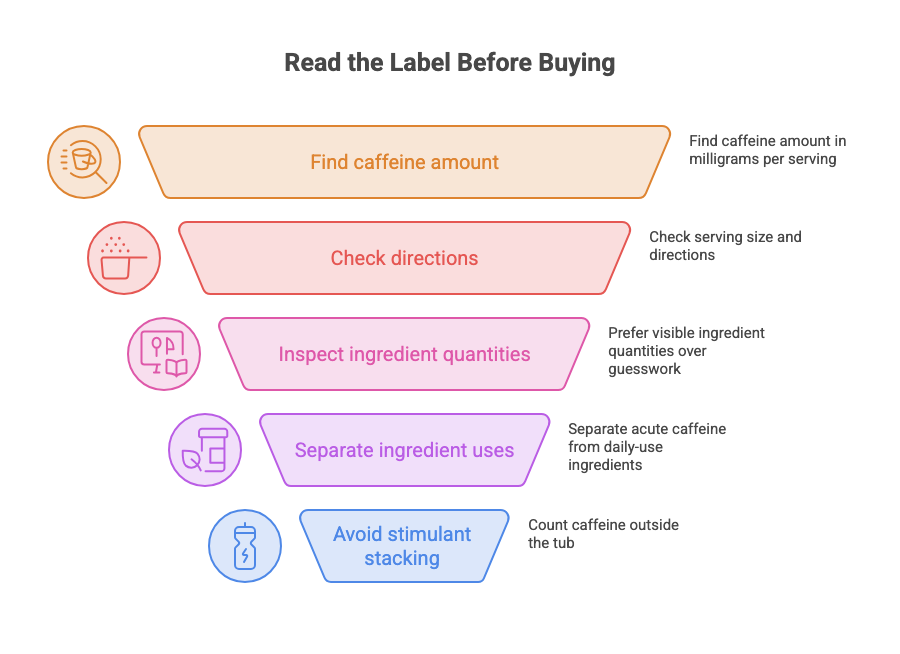
A pre-workout name, flavour, or “extreme” marketing language tells you very little about whether it suits a beginner. Read the complete product label and decide before you buy, not after you have mixed a full serving.
1. Find caffeine per stated serving
Look for the caffeine amount in milligrams per serving and check whether the serving is one scoop, two scoops, or another measure. Terms such as caffeine anhydrous describe an ingredient form; they do not replace the need to find the total labelled caffeine amount.
If a label does not clearly state what you need to know, that is a reason to pause rather than infer a dose. The FDA notes that caffeine amounts in packaged products are often voluntarily provided, so label transparency is especially useful for comparing products.
2. Check serving size and directions
A scoop only has meaning when it matches the product’s stated serving size and directions. Do not treat an online “dry scoop” trend as guidance. Mixing instructions, maximum-use directions, and warnings are part of the label, not small print to ignore.
The FDA explains that dietary supplements are not approved for safety and effectiveness before they are marketed. That makes careful label reading and a sensible purchasing route more valuable, not less.
3. Prefer visible ingredient quantities over guesswork
A proprietary blend may name ingredients without showing the amount of each one. The NIH professional fact sheet explains that the effects and safety of multi-ingredient combinations cannot be predicted unless that particular combination has been studied, and proprietary blends can hide individual quantities.
This does not mean every multi-ingredient product is automatically inappropriate. It means a beginner should be able to identify what is in the serving and avoid treating an ingredient list as proof that the whole formula will deliver a particular result.
4. Separate acute caffeine from daily-use ingredients
Caffeine is commonly used for an acute effect around training. Ingredients such as creatine and beta-alanine should not be judged only by whether they are in a pre-workout scoop immediately before a session.
For more context, learn what pre-workout supplements do, read about citrulline malate for pump and performance, and see what beta-alanine does. Beta-alanine can cause temporary tingling for some people; it is not a measure of product quality or a signal to take more.
Creatine is generally discussed as a consistent, daily-use supplement rather than a stimulant-like one-time boost. Readers comparing categories can explore Scitec creatine monohydrate and how to take creatine for best results separately.
5. Avoid casual stimulant stacking
A coffee, an energy drink, and a pre-workout can all contribute caffeine to one day. A transparent label helps only if you also count the coffee, beverages, foods, and medicines outside the tub. Never assume that products are safe to combine because each is sold separately.
Why coffee, pre-workout, and energy drinks should not be stacked casually
“Stacking” means combining more than one stimulant source in a day or close together—for example, morning coffee, an energy drink in the afternoon, then a caffeinated pre-workout before the gym. The risk is not a single magical combination; it is losing track of total caffeine and of how your body is responding.
Use a basic source list rather than a personalised calculator: write down the caffeine amount on each known label, mark coffee as variable, and leave room for other sources later in the day. If you cannot identify the amount, choose caution instead of trying to make it fit.
People who are pregnant or breastfeeding, under 18, unusually caffeine-sensitive, concerned about blood pressure or cardiovascular symptoms, managing a condition, or taking medicines should not use general adult guidance as personal clearance. Speak with a qualified healthcare professional or pharmacist before treating a pre-workout as routine.
Evening training and stimulant-free options in Lebanon
Training late does not obligate you to choose between a large coffee and a stronger caffeinated pre-workout. If caffeine near bedtime affects your sleep, a stimulant-free pre-workout or no pre-workout may better protect the recovery your training depends on.
“Stimulant-free” generally means a formula is designed without caffeine, not that it needs no scrutiny. Check the full ingredients, directions, allergens, and suitability for you. A non-stimulant label is a category description, not a guarantee of a particular pump, energy, or performance outcome.
Browse supplements to prepare before training if you want to explore pre-training support beyond caffeine. The pre-workout supplement collection also lets you compare current category options after you have decided whether a stimulant fits your schedule.
Buying pre-workout in Lebanon: authenticity and support checklist
Local shopping is about more than choosing a flavour. Use a retailer with a complete product page, visible serving and ingredient information where available, an expiry or lot check on the physical product in line with manufacturer guidance, and a clear route for customer support. Packaging details can be useful to inspect, but a visual cue alone does not prove authenticity.
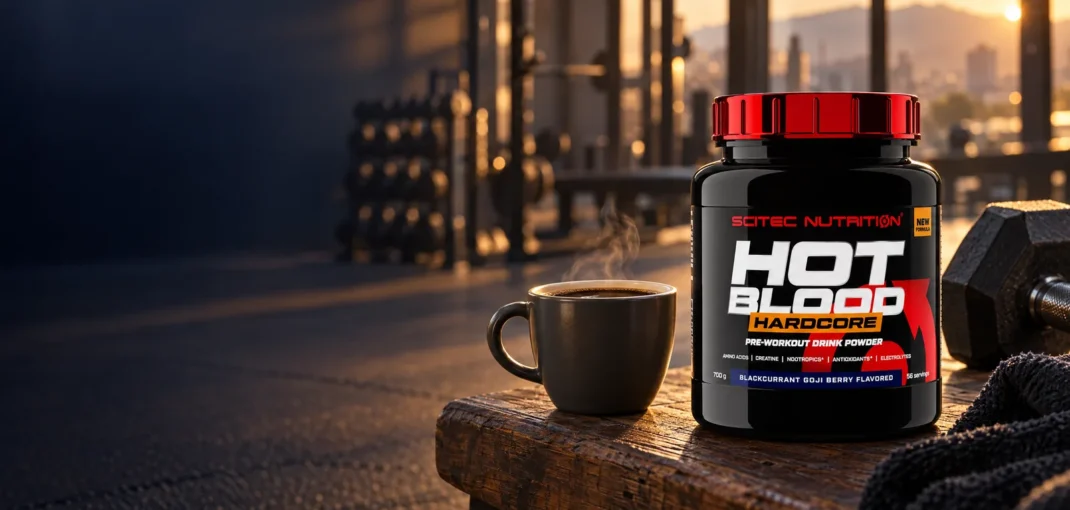
Choose a formula from the stated label and your training time, not from the most aggressive marketing claim. You can shop pre-workout supplements in Lebanon to compare live product pages. Scitec Nutrition Hot Blood Hardcore is one live product-page example to read, not a universal beginner recommendation; readers exploring the range can also browse Scitec Nutrition supplements.
For transparent retailer context, Muscle Plus says it is the official and exclusive Scitec Nutrition agent in Lebanon; read about Muscle Plus, Scitec Nutrition’s agent in Lebanon. That distribution status does not replace your own label check, tolerance assessment, or need for individual advice. If a label is unclear, you can contact Muscle Plus for product advice before purchasing.
A beginner decision tree: four honest outcomes
Choose coffee
Choose coffee if you want a familiar routine, tolerate it well, and are comfortable accounting for its variable caffeine content. Keep it simple and avoid turning an ordinary coffee into the first half of a stimulant stack.
Consider a transparent-label caffeinated pre-workout
Consider a transparent-label caffeinated pre-workout if you want to see the stated caffeine amount and full ingredient panel. Follow the specific label conservatively, do not copy an internet challenge, and seek individual advice first when the safety caveats in this guide apply.
Consider stimulant-free
Consider stimulant-free if you train late, prefer to avoid caffeine effects, or already know that caffeine affects your sleep or comfort. Read the label with the same care; stimulant-free does not mean automatically suitable for every person.
Choose neither today or seek advice first
Choose neither today, or seek advice first, if you feel unwell, are already using several caffeine sources, cannot identify the caffeine amount, have had concerning symptoms, or fall into a group for whom general adult guidance may not apply. This is a valid training decision, not a missed opportunity.
Frequently asked questions
Coffee vs pre-workout: which is better for beginners?
Neither is automatically better. Coffee can suit a beginner who likes it, tolerates it, and can account for its variable caffeine content. A transparent-label pre-workout can suit someone who wants to inspect the stated caffeine amount and ingredients. If sleep, sensitivity, health context, or uncertainty is the main issue, a stimulant-free option or neither may be the better choice.
How much caffeine is in coffee compared with pre-workout?
Coffee caffeine varies with the drink, bean, size, and brew, so there is no dependable cup-to-scoop conversion. A pre-workout should be assessed by the caffeine amount and serving size shown on its current label. Compare the product label with your full-day caffeine intake rather than assuming that a coffee and a scoop are equivalent.
Can I have coffee and pre-workout on the same day?
They can both contribute to your daily caffeine total, so do not combine them casually. List coffee, tea, energy drinks, foods, supplements, and relevant medicines before deciding. If the total is unclear, you feel stimulant effects, or individual safety caveats apply to you, choose caution and ask a qualified healthcare professional for personal advice.
How long before training should I drink coffee or take pre-workout?
Caffeine research commonly studies use around 60 minutes before exercise, but the best timing is not identical for every source or person. Start with a familiar routine, account for your session time and sleep, and follow the specific product directions. Avoid late caffeine if it disturbs your sleep, even if a training plan appears to call for it.
Does coffee before a workout dehydrate you?
Coffee is not automatically dehydrating during exercise, but it also does not replace an appropriate fluid plan. Drink fluids according to your session, environment, and sweat loss. If coffee causes stomach discomfort or a frequent urge to use the bathroom, it may not be the practical pre-workout drink for you.
What is a stimulant-free pre-workout?
A stimulant-free pre-workout is generally a formula designed without caffeine. It may be useful for late training or for people who want to avoid caffeine effects, but it still requires a full label check. Ingredients, directions, allergens, and your own health context matter just as much as they do with a caffeinated product.
هل القهوة قبل التمرين مفيدة؟
يمكن أن تكون القهوة خياراً عملياً قبل التمرين لمن يتحمّل الكافيين ويرغب في روتين مألوف. لكن كمية الكافيين تختلف حسب نوع القهوة وطريقة التحضير وحجم المشروب، وقد لا تناسب من يشعر بالقلق أو اضطراب المعدة أو تأثر النوم. لا تُعد القهوة ضرورية لنجاح التمرين.
هل يمكن شرب القهوة والبري ووركاوت في اليوم نفسه؟
يمكن أن يضيف كلاهما إلى إجمالي الكافيين اليومي، لذلك لا تجمعهما بشكل عشوائي. احسب القهوة والشاي ومشروبات الطاقة والمكملات والأطعمة والأدوية ذات الصلة قبل اتخاذ القرار. إذا كانت الكمية غير واضحة أو ظهرت أعراض مزعجة، فاختر الحذر واستشر مختصاً مؤهلاً للحصول على نصيحة فردية.
متى أشرب الكافيين قبل التمرين؟
تستخدم أبحاث الكافيين غالباً توقيتاً يقارب 60 دقيقة قبل التمرين، لكن الاستجابة تختلف حسب المصدر والشخص ووقت النوم. اتبع تعليمات المنتج إن وُجدت، وابدأ بروتين مألوف، وتجنب الكافيين المتأخر إذا كان يؤثر في نومك. لا تحوّل توقيت الأبحاث إلى وصفة شخصية ثابتة.
Choose clarity before a stronger stimulant
The right pre-workout choice is the one whose caffeine and ingredient information you can understand, and whose effects fit your training time, total intake, and tolerance. If a stimulant product is not your immediate priority, read best gym supplements for beginners in Lebanon for broader beginner context. When you are ready to compare current options, shop pre-workout supplements in Lebanon or contact Muscle Plus for product advice with the product label in front of you.Written by the Muscle Plus Editorial Team — Supplement Specialists
For individual advice, consult a qualified healthcare professional.