
If you compare a dirty bulk vs clean bulk, the better choice for most lifters is a controlled clean—or lean—bulk. It supports muscle gain while limiting unnecessary fat gain, gives you more nutritious food choices, and reduces the size of the cutting phase you may need later.
That does not mean every meal must be “perfect.” Clean and dirty bulking are informal fitness labels, not scientific categories. What matters most is the size of your calorie surplus, your protein intake, the quality of your training, your food pattern, and how consistently you monitor progress.
The practical verdict: Build most of your diet around nutrient-dense foods, use a modest calorie surplus, and add convenient calorie-dense foods or supplements only when they help you meet a real need.
What Does Bulking Mean?
Bulking is a period in which you combine progressive resistance training with enough energy and protein to support muscle growth. Some people deliberately eat above maintenance calories; others—especially beginners or people returning to training—may gain muscle at maintenance or even in a calorie deficit.
The surplus is therefore a tool, not the goal. The goal is to improve muscle size, strength, and training performance without accumulating more body fat than necessary. A scientific review of off-season bodybuilding nutrition notes that the ideal surplus is not known precisely and should be adjusted for training experience, body composition, and individual response.
Clean Bulk vs Dirty Bulk: The Key Difference
A clean bulk usually means a controlled calorie surplus built mostly from minimally processed, nutrient-dense foods. A dirty bulk usually means eating a much larger or poorly tracked surplus, often with frequent fast food, sweets, fried foods, and other highly palatable calorie-dense choices.
The terms can be misleading. You can gain too much fat while eating only “clean” foods if the surplus is too large. You can also include pizza or dessert occasionally and still run a well-controlled lean bulk. Food quality and surplus size are separate variables.
| Factor | Controlled clean or lean bulk | Unrestricted dirty bulk |
| Calorie target | Modest and monitored | Often large, inconsistent, or untracked |
| Main food pattern | Mostly nutrient-dense meals | More reliance on fast food and ultra-processed snacks |
| Rate of weight gain | Gradual | Usually faster |
| Muscle-gain potential | Supports growth when training and protein are adequate | Does not guarantee more muscle despite faster scale gain |
| Fat-gain risk | Lower when the surplus is adjusted | Higher because extra calories can exceed the amount useful for growth |
| Micronutrients and fibre | Easier to cover consistently | Can be displaced by lower-quality choices |
| Appetite | May require planning for hardgainers | Easy to consume more calories |
| Digestion and energy | Often steadier when meals are balanced | Large, rich meals may be harder to tolerate |
| Later cutting phase | Usually shorter and easier | Often longer because more fat must be lost |
| Best fit | Most beginners, intermediate lifters, and advanced athletes | Rarely necessary; limited practical advantage |
Does Dirty Bulking Build More Muscle?
Dirty bulking usually increases body weight faster. That is not the same as increasing muscle tissue faster.
Muscle growth is constrained by your training stimulus, recovery, protein intake, training age, genetics, and other individual factors. Once energy availability is adequate, adding hundreds of extra calories does not force muscle to grow at the same rate as the scale.
A 2023 study compared resistance-trained adults assigned to maintenance calories, an estimated 5% surplus, or an estimated 15% surplus while following supervised training. Faster body-mass gain primarily predicted greater increases in skinfold thickness rather than clearly superior muscle-thickness or most strength outcomes, according to the controlled energy-surplus study. The study was small and lasted only eight weeks, so it should not be treated as the final answer. However, it supports a practical conclusion: a larger surplus can add fat faster without a proportional muscle-building benefit.
The smarter question is not “How much can I eat?” It is “What is the smallest surplus that keeps my body weight and gym performance moving in the right direction?”
Why a Controlled Clean Bulk Usually Wins
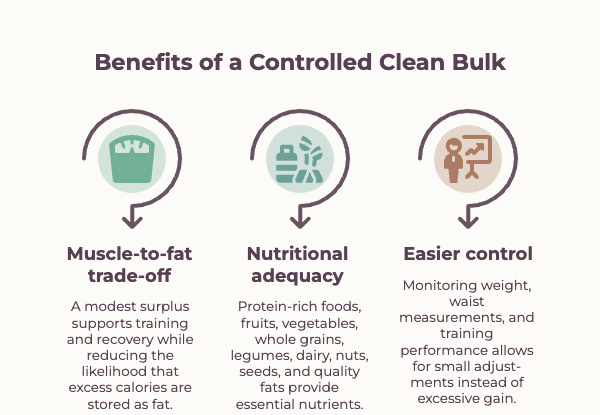
It improves the muscle-to-fat trade-off
A modest surplus gives your body enough energy to support training and recovery while reducing the likelihood that excess calories are stored as fat. The off-season bodybuilding nutrition review generally recommends slower gains for experienced lifters because their potential rate of new muscle growth is lower.
This matters after the bulk. Gaining less unnecessary fat can shorten the later cutting phase, reduce diet fatigue, and help you spend more time training productively. If that phase is approaching, our guide to cutting while keeping muscle explains the next step.
It makes nutritional adequacy easier
A productive bulk requires more than calories. Protein-rich foods, fruits, vegetables, whole grains, legumes, dairy or suitable alternatives, nuts, seeds, and quality fats provide the amino acids, carbohydrate, fibre, vitamins, and minerals that support training and general health.
The World Health Organization describes adequacy, balance, moderation, and diversity as the foundations of a healthy diet and recommends varied minimally processed foods as its base. That does not make processed food forbidden. It means highly processed choices should not displace the foods that cover your nutritional needs.
It is easier to control
An inpatient randomized trial found that participants ate about 508 more calories per day on an ultra-processed diet than on a matched unprocessed diet when allowed to eat freely. This was a short study in 20 adults, not a bodybuilding trial, so it does not prove that every processed food causes fat gain. It does show why a food environment dominated by easy-to-eat, energy-dense products can make an intended small surplus become a large one.
A controlled bulk gives you feedback. When weight, waist measurements, and training performance are reviewed together, you can make small adjustments instead of reacting after months of excessive gain.
How to Set Up a Clean Bulk
1. Estimate maintenance calories
Track your food intake and morning body weight for one to two weeks under normal conditions. If your weekly average weight is stable, your average calorie intake is a useful starting estimate of maintenance.
Online calculators can provide an initial number, but they cannot measure your true energy expenditure. Treat any estimate as a hypothesis, then correct it using your trend.
2. Choose a conservative starting surplus
A practical starting point is approximately 5–10% above maintenance for advanced lifters or anyone who gains fat easily, and roughly 10–15% for many beginners and intermediate lifters. These are starting ranges, not guarantees.
For example, if an 80 kg lifter maintains weight at 2,600 calories, an 8% surplus is about 2,808 calories per day. The plan should then be judged by several weeks of progress, not by the calculation alone.
A useful rate-of-gain range is around 0.25–0.5% of body weight per week, with advanced trainees usually aiming toward the slower end, as outlined in the off-season bodybuilding nutrition review. For an 80 kg person, that is approximately 0.2–0.4 kg per week. New lifters, very lean people, and individuals returning after a long break may respond differently.
3. Set protein first
A strong practical target is 1.6–2.2 g of protein per kilogram of body weight per day. A meta-analysis of 49 resistance-training trials found that the average additional benefit to fat-free-mass gain levelled off around 1.62 g/kg/day, while the upper confidence limit supports room for individualization up to about 2.2 g/kg/day.
For a more personalized explanation, read how much protein you need per day or use the Muscle Plus Protein Calculator.
Spread protein across the day rather than depending on one very large meal. A review of per-meal protein distribution supports a practical framework of about 0.4–0.55 g/kg per meal across four meals, adjusted to your schedule and total target. The ISSN protein position stand notes that whole foods can cover protein needs, while supplements are a practical option for quantity, quality, or convenience. Browse protein powders only if regular meals leave a consistent gap.
4. Use carbohydrate to support training
After setting protein and enough dietary fat for preference and health, use carbohydrate for much of the remaining calorie budget. Rice, potatoes, oats, bread, pasta, fruit, and legumes can help fuel demanding sessions and replenish glycogen, consistent with the ISSN nutrient-timing position stand.
Meal timing is secondary to total daily intake, but a meal containing carbohydrate and protein before or after training can support performance and recovery. For practical examples, see what to eat before and after the gym.
5. Build meals around a simple template
Most meals can include a quality protein source, a carbohydrate source, produce, and a source of fat. Lebanese staples fit this structure easily: chicken with rice and salad; eggs with whole-grain bread and vegetables; lentils with rice and yogurt; lean meat with potatoes; or labneh with bread, fruit, and nuts.
A sample day might look like this:
| Meal | Example clean-bulk structure |
| Breakfast | Oats, milk or yogurt, banana, whey if needed, and tahini or nuts |
| Lunch | Chicken or lean beef, rice, fattoush, and yogurt |
| Pre-workout | Bread with labneh or turkey, plus fruit |
| Post-workout or dinner | Fish, chicken, or legumes with potatoes or pasta and vegetables |
| Flexible snack | Fruit, yogurt, nuts, a homemade shake, or convenient meals and high-protein snacks |
This is a structure, not a prescription. Portions depend on your calorie target, appetite, training volume, dietary preferences, and medical needs.
What If You Are a Hardgainer?
“Hardgainer” often describes someone with a low appetite, high activity level, or difficulty eating consistently—not a person who is immune to energy balance. The solution is usually to make the target easier to reach without turning every meal into fast food.
Increase calorie density with olive oil, tahini, nuts, nut butter, dried fruit, avocado, full-fat dairy if tolerated, and larger portions of rice, pasta, bread, or potatoes. Smoothies can combine milk, oats, fruit, yogurt, nut butter, and protein powder in a form that may be easier to consume than another solid meal.
Keep fibre-rich foods in the diet, but avoid forcing an enormous salad or high-fibre meal immediately before training if it makes you feel too full. Smaller, more frequent meals can also be more manageable than three oversized servings.
If regular food still does not close the gap, weight gainers can be useful. Compare calories, protein, carbohydrate, sugar, fat, serving size, and ingredients. A mass gainer is not automatically “dirty”; its role depends on the total diet, dose, and whether it solves a genuine calorie problem.
Supplements: Useful Tools, Not a Bulking Strategy
Whey protein
Whey helps you reach a protein target with minimal preparation. It does not build more muscle than a diet that already supplies enough high-quality protein, but it can improve convenience. It can be mixed with oats, fruit, milk, or yogurt when you need more calories, or with water when you only need protein.
Creatine monohydrate
Creatine supports high-intensity training capacity and can improve training adaptations over time. It does not create a calorie surplus and should not be used to disguise an inconsistent diet or program.
A simple evidence-based approach is 3–5 g of creatine monohydrate daily. Loading is optional; A slower daily approach also raises muscle creatine stores over time, according to the ISSN creatine position stand. See how to take creatine for best results for a complete guide.
Mass gainers
A mass gainer is primarily a convenient source of calories, carbohydrate, and protein. It may help people with low appetite, long workdays, or high energy needs, but it can also make a surplus too large if the full serving is added without monitoring total intake.
Start with the amount needed to close your actual calorie gap, not automatically the largest label serving. Review progress exactly as you would with food.
How to Track and Adjust Your Bulk
Use a weekly system instead of reacting to one weigh-in. Body weight changes with sodium, carbohydrate, digestion, hydration, and creatine use, so a single day is noisy.
- Weigh yourself under similar morning conditions at least three times per week.
- Calculate the weekly average and compare it with the previous two weeks.
- Log your main lifts, repetitions, and training quality.
- Measure your waist every one to two weeks and take monthly photos under similar conditions.
- Keep calories unchanged while your rate of gain and performance are appropriate.
If your average weight has not moved for two consecutive weeks and adherence is good, add roughly 100–150 calories per day. If weight and waist are rising faster than intended for two weeks, reduce intake by about 100–200 calories per day. These are practical adjustment increments rather than universal scientific thresholds.
Do not change the plan because of one high-sodium meal, one missed workout, or one flat weigh-in. Trends make better decisions than daily emotion.
How to Switch From a Dirty Bulk to a Lean Bulk
You do not need to crash-diet. First, record your current intake for several days. Then reduce the obvious surplus—large liquid-calorie additions, frequent takeout, oversized snack portions, and untracked sauces—while keeping protein and training consistent.
Replace, rather than merely remove. Exchange some fried or highly processed choices for meals built around lean protein, rice or potatoes, fruit, vegetables, dairy, legumes, and quality fats. Keep the foods you genuinely enjoy in sensible portions so the plan remains sustainable.
Hold the new intake for two weeks and review the trend. If body weight is still rising too quickly, reduce slightly again. If weight stops completely and gym performance stalls, add a small amount back.
When a Bulk May Not Be the Right Goal
A dedicated surplus may not be the best starting point for everyone. Beginners with higher body-fat levels may be able to gain muscle around maintenance calories while improving food quality and training. Anyone with diabetes, kidney disease, digestive conditions, a history of disordered eating, or other medical concerns should obtain individualized guidance from a qualified clinician or dietitian before making a major dietary change.
Adolescents should avoid aggressive bulking and supplement decisions without appropriate adult and professional guidance. Training quality, regular meals, adequate sleep, and a varied diet should come first.
Dirty Bulk vs Clean Bulk: Final Verdict
In the dirty bulk vs clean bulk debate, a controlled lean bulk is the better default for most people. Dirty bulking can move the scale faster, but the additional gain is not automatically muscle. A modest surplus, sufficient protein, progressive training, nutritious foods, and regular adjustments provide a better balance of growth, health, and long-term consistency.
The best plan is neither rigid nor reckless. Build a nutrient-dense foundation, leave room for enjoyable foods, and use supplements only when they improve convenience or training support.
Muscle Plus is the official and exclusive Scitec Nutrition agent in Lebanon. If you need help comparing a protein powder, creatine product, or mass gainer with your actual nutrition goal, contact the Muscle Plus team for product guidance—without treating supplements as a substitute for the fundamentals.
Frequently Asked Questions
Is dirty bulking faster than clean bulking?
Dirty bulking usually makes body weight increase faster because the calorie surplus is larger and easy-to-eat foods make overeating simpler. It does not necessarily build muscle faster. Once energy and protein are adequate, a larger surplus is more likely to increase fat gain without a proportional increase in muscle, as illustrated by the controlled energy-surplus study.
How many calories should I add for a clean bulk?
Start conservatively. Around 5–10% above maintenance may suit advanced lifters or people who gain fat easily, while 10–15% may suit many beginners and intermediate trainees. Use your two-week weight trend, waist, and training performance to adjust the number rather than treating it as permanent.
How fast should I gain weight while bulking?
A practical target is roughly 0.25–0.5% of body weight per week, with advanced lifters generally using the slower end, as discussed in the off-season bodybuilding nutrition review. Faster gain may be appropriate in limited situations, but it also raises the chance of adding unnecessary fat.
Can you build muscle without gaining fat?
It is possible, especially for beginners, people returning after time away, and some individuals with higher body-fat levels. However, trained and relatively lean lifters may find a small surplus more reliable. Even with a well-run bulk, a small amount of fat gain can occur.
How much protein do I need while bulking?
Approximately 1.6–2.2 g/kg/day is a useful evidence-based range for most resistance-trained adults seeking muscle gain, based on the protein supplementation meta-analysis. More is not automatically better. Total calories, training, sleep, and consistency still matter.
Is a mass gainer considered dirty bulking?
No. A mass gainer is a convenient calorie source. It becomes unhelpful when it drives your intake far above the surplus you need or displaces most nutrient-dense foods. Use the smallest practical serving that closes your measured calorie gap.
Do I need whey protein or creatine to clean bulk?
No supplement is required. Whey can make protein intake easier, and creatine monohydrate can support high-intensity performance and training adaptations. Neither replaces adequate food, progressive resistance training, or recovery.
How long should a clean bulk last?
There is no fixed duration. Continue while strength and muscle measurements improve, the rate of weight gain remains controlled, and body fat stays within a range you are comfortable maintaining. Reassess every four to six weeks instead of committing blindly to an end date.
Written by: Muscle Plus Editorial Team — Supplement ExpertsThe Muscle Plus editorial team produces evidence-led sports nutrition and supplement education for lifters in Lebanon. Research claims are checked against primary studies, systematic reviews, and professional position statements, while product recommendations remain secondary to food, training, and recovery fundamentals.
Commercial disclosure: Muscle Plus is the official and exclusive Scitec Nutrition agent in Lebanon. Product links and brand references are included transparently and should not be interpreted as a substitute for individualized medical or dietetic advice.