Written by the Muscle Plus Editorial Team — Supplement Experts for lifters in Lebanon Reviewed: October 2026
Mass Gainer Lebanon: When to Use One (Clean vs Dirty Bulk) answers one question. Does a gainer solve a real calorie-and-convenience problem in your plan? A mass gainer can help when food, time, or appetite makes a controlled surplus hard to reach. It is not a shortcut around training, sleep, protein, or balanced meals.
For most lifters, a controlled clean or lean bulk is the better default. Build the foundation with whole foods. Track your trend. Add a mass gainer only when it closes a measured gap. That approach gives you more control than simply eating everything in sight.
The short answer
A mass gainer can make sense when you train consistently and know your calorie target. It helps when normal meals still leave you short. Common reasons include a low appetite, long workdays, or a busy university schedule. Some people simply cannot face another large meal.
It does not automatically make a bulk “dirty”. Your total intake, serving size, food pattern, and adjustments still matter. A shake can be practical. An untracked full serving can make a small surplus far too large.
Before choosing any supplement, set your calorie target for muscle gain. If you do not yet know whether you are actually under-eating, start there.
Clean bulk vs dirty bulk: what really changes?
“Clean” and “dirty” bulk are informal fitness labels, not medical categories. The useful distinction is simple. A controlled surplus supports training. An excessive, poorly monitored intake can make unnecessary fat gain more likely.
A review on energy surplus and muscle hypertrophy concludes that there is no single surplus prescription for everyone. Training history, body composition, recovery, and progress all matter. Start conservatively and monitor the result. That is more useful than chasing the biggest possible calorie number. Read the full review in Frontiers in Nutrition.
| Approach | What it looks like | Main advantage | Main trade-off |
| Controlled clean/lean bulk | Mostly nutrient-dense meals, a deliberate calorie surplus, regular tracking | Better control of food quality and body-composition trend | Requires preparation and adjustment |
| Flexible bulk | A nutritious food base with room for convenient foods you enjoy | Often easier to sustain socially and practically | Still needs portions and trend checks |
| Dirty bulk | A large, untracked surplus with frequent reliance on highly processed, easy-to-overeat foods | Fast scale-weight gain | Higher chance that the gain outpaces what training can use productively |
A clean bulk is not a “perfect food” diet
A clean bulk does not require every meal to be plain chicken, rice, and vegetables. It means your usual food pattern gives you protein, carbohydrate, produce, fibre, and dietary fats. Your calorie surplus should still stay intentional. Lebanese meals can fit well. Choose foods such as rice, potatoes, chicken, fish, eggs, lentils, yogurt, labneh, fruit, olive oil, tahini, nuts, and bread to suit your portions and preferences.
The NHS healthy-weight-gain guidance recommends gradual gain and balanced meals. It also recommends nutritious high-energy foods and smaller frequent meals when appetite is limited. That is a more reliable foundation than treating takeaway food as a muscle-building strategy.
Dirty bulking is not made “better” by a bigger shake
A larger calorie surplus does not guarantee a proportional increase in muscle. Progressive resistance training, adequate protein, sleep, and time set the ceiling. Extra calories above what you can use may simply move waist measurements faster than gym performance.
If you want the broader comparison, use our controlled clean vs dirty bulk guide. This article stays focused on the next decision: whether a mass gainer belongs in your own plan.
Mass Gainer Lebanon: When to Use One
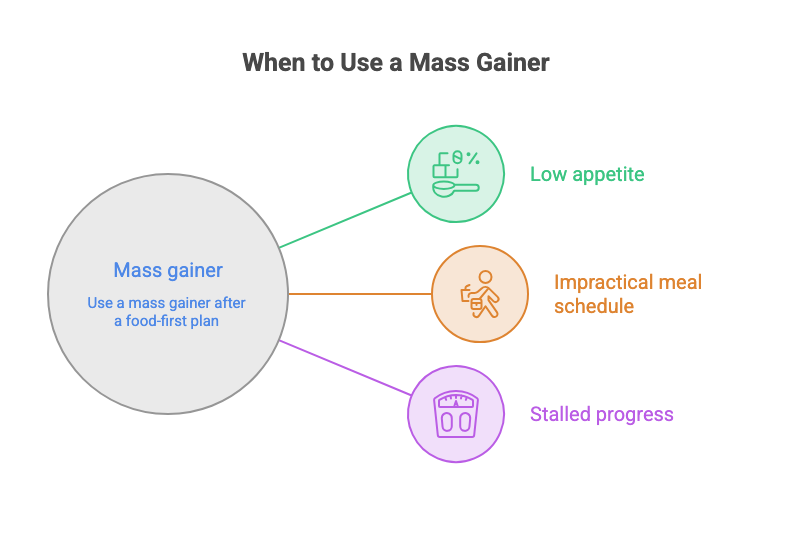
Use a mass gainer after you have tried a food-first plan and can identify the specific gap it fixes. The best reason is not “I want to gain quickly.” The best reason is “my training and food plan are consistent, but I cannot reliably reach the energy intake I planned.”
You have a low appetite or feel too full from solid meals
Some lifters cannot comfortably add a fourth large meal. A blended drink can be easier to finish than more rice, bread, or meat. Start with food-based calories. Try milk or yogurt if tolerated, oats, fruit, nut butter, tahini, or olive oil in meals. Use a gainer only if the gap remains.
A gainer is especially useful when liquid calories improve consistency without making you skip meals. It should add to your eating plan, not replace breakfast, lunch, and dinner.
Your schedule makes a planned meal impractical
A packed commute, shift work, or long campus day can make meal preparation difficult. A portable shake can be a sensible bridge between meals or after training when you cannot access a full meal soon.
Convenience is a valid use case. The key is to measure the serving against your daily target rather than using the largest label serving by default. If one half-serving solves the gap, one half-serving is the better starting point.
Your progress has stalled despite honest tracking
Check whether your average body weight, gym performance, and food log have been flat for two or more weeks. If so, you may need more energy. First check consistency. Missed meals, changing portions, weekend intake, and training volume often explain an apparent plateau.
If adherence is genuinely solid, a gainer can provide a repeatable calorie addition. Record it like any other food. A supplement is useful because it is measurable and convenient—not because it has special muscle-building powers.
When food comes before a mass gainer
Food-first is usually the best move when meals are unplanned or protein is inconsistent. It is also the best move when vegetables, fruit, and fibre have disappeared from your diet. A gainer cannot fix those fundamentals.
Prioritise food, planning, or professional support first if any of these apply:
- You have not estimated maintenance intake or monitored a body-weight trend yet.
- You are skipping regular meals and hoping a shake will compensate.
- You have frequent bloating, reflux, diarrhoea, or a known intolerance that needs attention.
- You have unexplained weight loss, an eating-disorder history, a medical condition, or medication questions.
For protein, the International Society of Sports Nutrition’s position stand notes that most exercising people seeking muscle gain can generally meet needs within 1.4–2.0 g per kilogram of body weight per day. Whole foods can meet that target; supplements mainly make quantity and convenience easier. Use the Muscle Plus Protein Calculator as a starting tool, then adjust for your own training and diet.
Build the surplus with Lebanese foods first
A clean bulk is easier to control when each meal has a simple job: protein for your daily target, carbohydrate to support training, produce for variety, and fats that make meals satisfying and energy-dense.
Use a simple meal-building template
Build most meals around one protein source, one carbohydrate source, vegetables or fruit, and a fat source. Examples include eggs with bread and labneh; chicken with rice and salad; lentils with rice and yogurt; fish with potatoes; or oats with milk, banana, and tahini.
These are flexible meal ideas, not a prescription. Portions depend on body size, appetite, activity, dietary preference, and health context. For the complete training-and-nutrition framework, read the complete bulking guide.
Increase calorie density before adding random junk food
When appetite is the obstacle, increase energy without turning every meal into fast food. Add olive oil to rice or vegetables, tahini or nut butter to oats and shakes, nuts beside fruit and yogurt, or an extra serving of bread, rice, pasta, or potatoes.
That is not a moral rule about “good” and “bad” foods. It is a practical way to keep a surplus compatible with fibre, micronutrients, digestion, and training quality. Leave room for foods you enjoy; just keep the weekly trend intentional.
Track trends, not one scale reading
Weigh under similar morning conditions several times each week and compare weekly averages. Pair the trend with main lifts, appetite, digestion, and an occasional waist measurement. Sodium, hydration, carbohydrate intake, and digestion can move the scale from one day to the next.
If progress is appropriate, do not change the plan. If the average trend is repeatedly flat despite good adherence, add a small, repeatable amount. If weight and waist rise faster than you intend, reduce the easiest excess. This is often an oversized shake, untracked snacks, or frequent takeaway additions.
How to use a mass gainer without creating a dirty bulk
A mass gainer should be portioned like food, not treated as an all-or-nothing “bulking mode.” Start with the smallest serving that closes your actual gap. Give your digestion and weekly trend time to respond.
Start smaller than the maximum label serving
Many gainers are designed to deliver substantial calories. Begin with a partial serving or split it between two times of day if that is enough for your plan. This can be easier on digestion and makes it less likely that the gainer pushes your surplus beyond what you intended.
Check the label for calories, protein, carbohydrate, fat, ingredients, allergens, preparation instructions, and serving size. If you are lactose-sensitive, have a food allergy, or use medication, ask a qualified clinician or dietitian before self-directing a new product.
Use timing for convenience, not superstition
Use a gainer where it helps you eat consistently: between meals, after training when a solid meal is delayed, or on a high-demand day. Total daily intake and repeatable training matter more than finding a “magic” minute.
Resistance exercise and protein work together to stimulate muscle protein synthesis, but the same ISSN position stand notes that the useful feeding window is flexible. A shake is therefore a convenient option around training, not a substitute for the rest of the day’s food intake.
Review and adjust after two weeks
Keep your food plan, training, and gainer serving consistent long enough to see a trend. If body weight is flat and performance is stable, you may need a modest increase. If you are gaining faster than planned or your waist is rising rapidly, reduce the serving before blaming all your meals.
This feedback loop is what separates a controlled bulk from a dirty bulk. The gainer should make your plan easier to follow, not make it impossible to read.
Compare the label before you choose
Do not buy a gainer based only on the front label or the biggest calorie number. Compare products against the job you need them to do.
- Calories per serving: Does the serving fill your real gap, or is it much larger than you need?
- Protein and carbohydrate: Does the product help your daily targets without making them difficult to manage?
- Ingredients and tolerance: Check dairy, sweeteners, fibre, allergens, and any ingredient that has affected you before.
- Preparation and portability: Consider whether you will actually use it consistently at home, work, university, or after training.
- Authenticity and support: Buy through a source that can give you current product information and accountable local support.
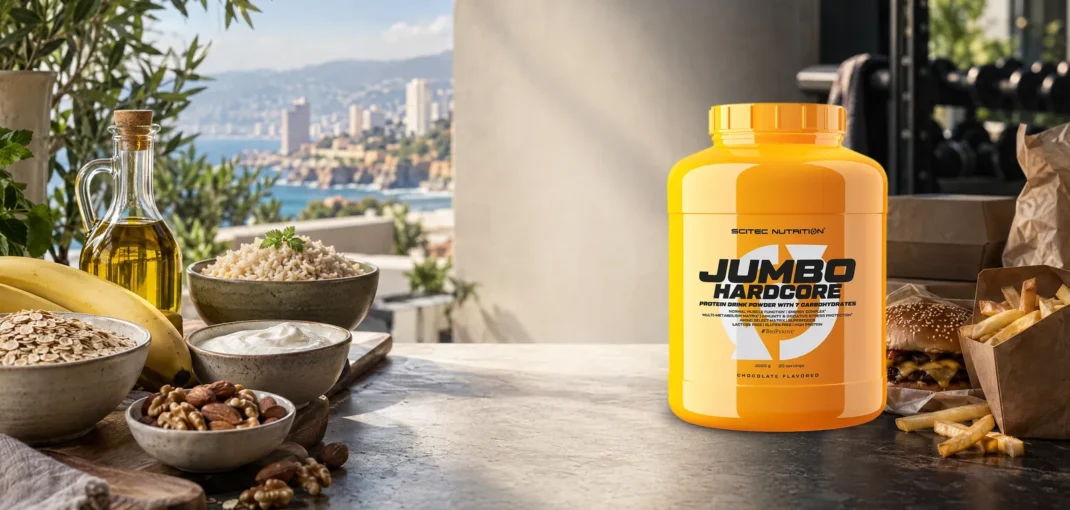
For example, the current Jumbo Hardcore product page lists 63 g protein, 65 g carbohydrate, and 7 g fat per serving, plus 3 g creatine. Those are product-specific facts—not a universal serving recommendation. Choose the amount that fits your calorie plan and tolerance, and recheck the live label before purchase because formulas and packaging can change.
Choosing a mass gainer in Lebanon
After you understand your gap, you can compare the best mass gainer supplements in Lebanon or browse the live mass-gainer collection. Use the product page as the source of truth for current packaging, ingredients, and options.
Muscle Plus is the official and exclusive Scitec Nutrition agent in Lebanon. That relationship should make product guidance and authenticity easier to verify; it does not change the core rule that the product must fit your food intake, training plan, and tolerance.
If you want a higher-protein recovery-oriented alternative to compare, the MyoMax Hardcore review explains its distinct use case. The best product is not the most extreme one—it is the one that solves the gap you actually have.
Who should get individual advice first?
Speak with a qualified clinician or dietitian before making major changes to diet or supplements if you have diabetes, kidney disease, digestive conditions, a history of disordered eating, food allergies, unexplained weight loss, or questions related to pregnancy, breastfeeding, medication, or adolescent nutrition.
If you have lost weight without trying, do not assume a mass gainer is the answer. The NHS advises speaking with a GP about unintentional weight loss, because it can signal an underlying issue that deserves proper assessment.
Frequently asked questions
Is a mass gainer the same as dirty bulking?
No. A mass gainer is a convenient source of calories, carbohydrate, and protein. Dirty bulking describes an excessively large or poorly monitored surplus. A gainer can fit a controlled bulk when the serving is measured against your plan and most meals remain balanced.
When should I use a mass gainer?
Use one when you train consistently, have a clear calorie target, and still struggle to reach it through meals because of appetite, time, or practical access to food. If meals are simply unplanned, improve food consistency first.
Can I build muscle without a mass gainer?
Yes. You can build muscle with progressive resistance training, enough total energy, sufficient protein, recovery, and regular meals. A gainer is optional convenience, not a requirement.
How much mass gainer should I take?
Start with the smallest practical serving that fills your measured calorie gap. Follow the current product label, monitor digestion and weekly progress, and adjust only after you have enough consistent data—not after one weigh-in.
What if a mass gainer upsets my stomach?
Stop or reduce the serving and review the ingredient list, preparation method, and timing. Persistent digestive symptoms, a suspected intolerance, or an allergy should be discussed with a qualified clinician or dietitian before you continue.
Should beginners use a mass gainer?
Beginners do not need a gainer by default. First establish regular meals, progressive training, a protein routine, and a realistic calorie target. A gainer can be useful later if a documented calorie gap remains despite those habits.
The bottom line
A mass gainer can help you bulk when it makes a controlled calorie surplus more practical. It should not be the foundation of your diet, a replacement for meals, or permission to stop tracking the outcome.
Build your plan with food, train progressively, and use the smallest serving that solves a genuine gap. If you want help comparing current Scitec Nutrition options to your goal, explore the Muscle Plus mass-gainer range or contact the team for product guidance.
Written by: Muscle Plus Editorial Team — Supplement Experts The Muscle Plus Editorial Team creates evidence-led sports-nutrition and product-guidance content for lifters in Lebanon. We use authoritative position statements and peer-reviewed nutrition research for material claims, while keeping product recommendations secondary to food, training, recovery, and individual tolerance.
Commercial disclosure: Muscle Plus is the official and exclusive Scitec Nutrition agent in Lebanon. Product links and brand references are included transparently. This article is educational and does not replace individualized medical or dietetic advice.